


When most military families hear about VA survivor benefits, they think about life insurance or a one-time death gratuity. That makes sense, but it overlooks an important benefit: a monthly, tax-free payment that some surviving spouses and family members may receive for years, and potentially for life.
It's called Dependency and Indemnity Compensation (DIC), and for an eligible family, it can make a meaningful difference in managing expenses after losing someone.
The rules aren't always straightforward, though. Here's what DIC pays in 2026, who qualifies, and how to apply without missing money you may be entitled to.
What Is VA Dependency and Indemnity Compensation?
DIC is a monthly, tax-free benefit paid by the Department of Veterans Affairs to eligible survivors of service members and veterans whose deaths were connected to military service or whose circumstances meet certain other VA requirements.
For 2026, the standard base DIC payment for an eligible surviving spouse is $1,699.36 per month, or approximately $20,392 annually.
That amount can increase if you have eligible dependent children, need assistance with daily activities, or meet other qualifying conditions.
Unlike life insurance, DIC isn't a lump-sum payment. And unlike VA Survivors Pension, standard surviving-spouse DIC isn't based on household income.
If you qualify, payments can continue as long as you remain eligible.
Check current amounts: VA's Official DIC Payment Rates
Who Qualifies for DIC?

Eligibility depends on your relationship to the deceased service member or veteran, the circumstances of their death, and—in some cases—the veteran's disability history.
Surviving Spouses
You may qualify if your spouse:
- Died while serving on qualifying active duty, active duty for training, or inactive duty training.
- Died from an illness or injury connected to military service.
- Died from another cause but had a qualifying total service-connected disability rating for a required period before death.
For the third situation, the general rules include a total disability rating held continuously for at least 10 years before death, or continuously from discharge for at least five years immediately before death. A separate one-year exception can apply to qualifying former prisoners of war.
A total rating may include Total Disability based on Individual Unemployability (TDIU).
You must also meet VA's surviving-spouse requirements. These generally involve the length or timing of your marriage, whether you had a child together, and certain cohabitation rules.
What about remarriage? Remarrying doesn't always end DIC eligibility. Certain remarriages at age 55 or older are protected, depending on when the remarriage occurred. If you've remarried, check the specific VA rules rather than assuming you're disqualified.
Surviving Children
Unmarried children may qualify for DIC if they meet the applicable dependency and service-related requirements.
Generally, this includes children under 18, qualifying students under 23, and certain adult children who became permanently incapable of self-support before age 18.
Whether a child receives a separate payment or is included in a surviving spouse's payment depends on the family's circumstances.
Surviving Parents
Parents may qualify for Parents' DIC, a separate, income-based benefit with different payment rates and requirements.
Check eligibility: VA DIC Eligibility Requirements
How Much Does DIC Pay in 2026?
The base payment is only the starting point. Depending on your situation, additional allowances may apply.
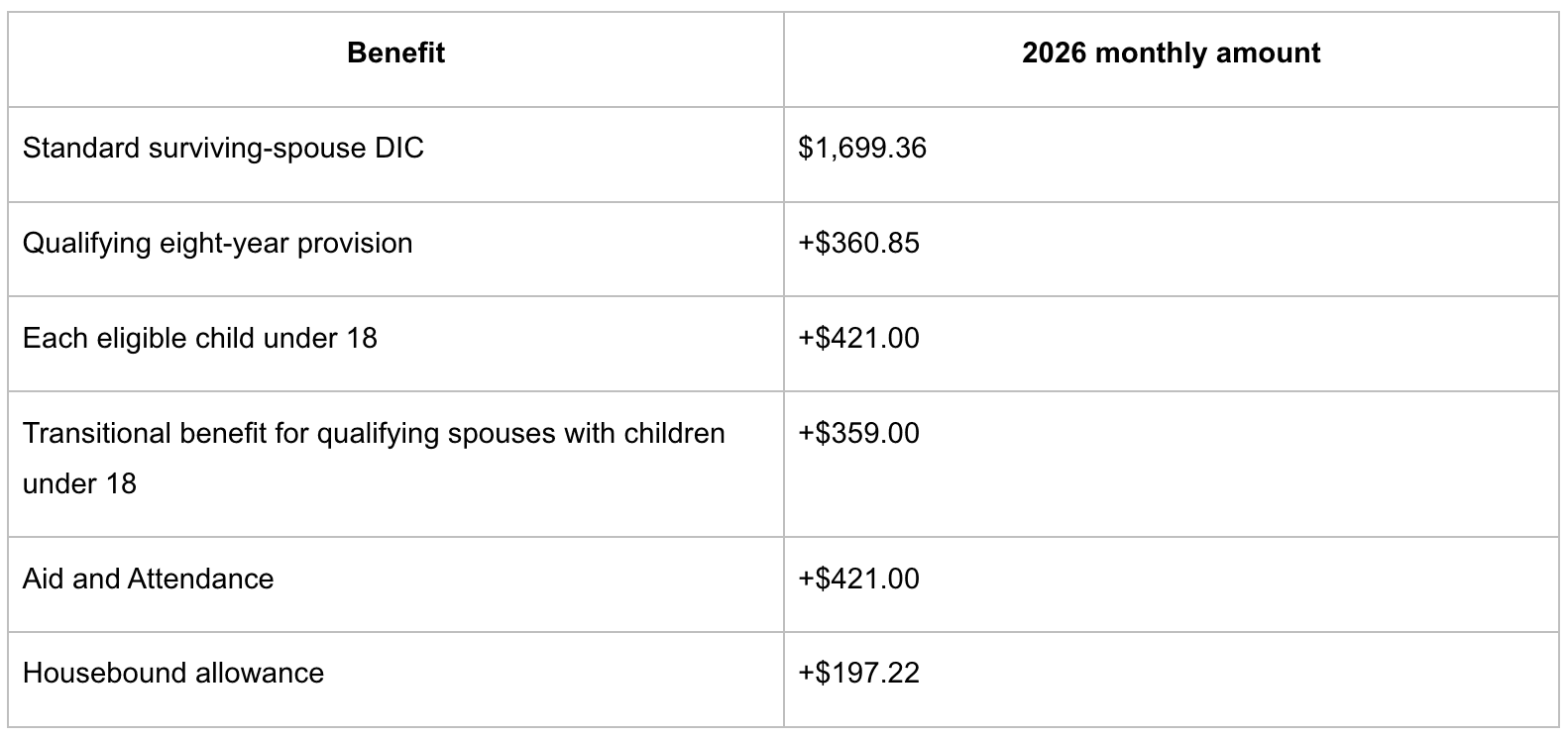
Rates effective December 1, 2025. These are not all automatically payable together, and special rate rules may apply.
Two benefits are particularly easy to confuse.
The eight-year provision adds $360.85 monthly when the veteran had a qualifying total disability rating for the eight full years before death and the surviving spouse was married to the veteran throughout that period. This is not simply a two-year benefit.
The transitional benefit provides an additional $359 monthly for the first two years after the veteran's death when the surviving spouse has qualifying children under 18.
What Could That Mean for a Family?
Consider a surviving spouse with two eligible children under 18 who qualifies for the transitional benefit.
Their monthly DIC could be:
- Base payment: $1,699.36
- Two children: $842.00
- Transitional benefit: $359.00
Total: $2,900.36 per month during the first two years.
After the transitional benefit ends, the payment would be $2,541.36, assuming the children remain eligible and rates don't change.
That's a meaningful amount of financial support for a household adjusting to the loss of an income.
How to Apply for DIC
You can apply using VA Form 21P-534EZ, the application for DIC, Survivors Pension, and accrued benefits.
The process is more manageable if you approach it one step at a time.
- Check your eligibility. Review the VA requirements, even if you're uncertain whether the death qualifies as service-connected.
- Gather supporting documents. These may include a death certificate, DD-214 or other service records, marriage certificate, children's birth certificates, and relevant medical evidence.
- Submit your application. Apply online through VA.gov, mail the completed form to the VA Pension Intake Center, or get assistance at a VA regional office.
- Consider free professional help. A VA-accredited Veterans Service Organization (VSO) representative can help prepare your claim, identify missing evidence, and communicate with VA.
Apply here: VA DIC Online Application
Don't Overlook the One-Year Filing Window
This is one of the most important details in the entire process.
If VA receives a qualifying DIC application within one year of the veteran's death, the effective date can generally go back to the first day of the month in which the death occurred.
If you apply more than a year afterward, the effective date is generally tied to when VA receives your claim, subject to exceptions.
For example, imagine a veteran dies in January and the surviving spouse submits a qualifying application in September of the same year. If approved, the benefit's effective date may reach back to January, even though the application was submitted months later.
That can mean substantial retroactive benefits. Actual payment commencement follows VA payment rules, so the effective date isn't necessarily the first payable day.
The takeaway is simple: don't wait until every question is answered before asking VA or an accredited VSO about filing.
Learn more: VA Effective Date Rules
Other Survivor Benefits Worth Checking
DIC may be one piece of a larger financial picture. Several other programs are worth reviewing, although each has its own eligibility requirements.
Survivor Benefit Plan (SBP): A Department of Defense retirement-related annuity. Since January 2023, qualifying survivors can receive full SBP and DIC payments without the former SBP-DIC offset.
CHAMPVA: Health coverage for certain eligible spouses and children who aren't eligible for TRICARE. DIC eligibility may overlap with CHAMPVA eligibility, but the requirements aren't identical.
VA Survivors Pension: A separate income- and net-worth-based program for qualifying survivors of wartime veterans. You generally cannot collect both Survivors Pension and DIC for the same period; VA determines the applicable benefit.
Fry Scholarship and DEA: Education programs that may help eligible surviving spouses and children pay for college or training. Eligibility and rules for combining benefits differ.
VA Home Loan Benefits: Certain surviving spouses may qualify for a VA-backed home loan, potentially without a down payment, subject to lender and VA requirements.
These programs aren't automatically approved when you receive DIC. Ask about them individually so you don't miss benefits your family may qualify for.
Explore: VA Survivor and Family Benefits
Frequently Asked Questions
Is DIC taxable?
No. VA DIC payments are exempt from federal income tax.
Can I receive DIC if my spouse wasn't rated 100% disabled?
Yes. If the death was connected to military service, a prior 100% disability rating isn't necessarily required. The long-term total-disability rules are a separate route to eligibility.
Can I receive Social Security survivor benefits and DIC?
Potentially, yes. They're separate programs with different eligibility rules, and receiving one doesn't automatically disqualify you from the other.
What if VA previously denied my DIC claim?
You may have options to request review or submit new evidence. Changes involving presumptive service connection, including certain PACT Act provisions, may also affect eligibility. An accredited VSO can help you review the decision.
Where to Start
Losing a spouse or parent brings enough difficult decisions without having to decipher complicated benefits rules alone.
If you think your family may qualify for DIC, start by checking the current VA eligibility requirements and gathering the basic records needed to apply.
You don't have to figure everything out yourself.
Find a free VA-accredited VSO representative: Get Help With a VA Benefits Claim
You can also call VA at 800-827-1000 for assistance.
The most important thing is knowing what support may be available—and taking the first step toward receiving it.

No comments yet. Be the first!