



PCS orders can change your address in a matter of months, but they should not have to erase your career momentum.
For military spouses, a portable career is more than a job labeled “remote.” The goal is to find work built around skills that employers need in many places, credentials you can transfer or maintain, an employer that can keep you on through a move, or a client base that can travel with you.
That does not mean every PCS will be easy. Licensing rules, child care, time zones, local hiring, security requirements, taxes, and employer policies can still create obstacles. But a deliberate career plan can reduce the odds that every move forces you to start from zero.
This guide will help you identify portable career paths, research the real barriers before you pay for training, and choose a practical next step for your current season of military life.
Key Takeaways
- A portable career can move with you through transferable skills, a realistic licensing pathway, remote-capable work, employer flexibility, or independent clients
- Before committing to a degree or certification, research licensing rules, interstate compacts, military-spouse accommodations, total cost, and job postings in likely future locations
- Healthcare, communication, technology, finance, education, and project-based work can all offer portable options, but each path has different training, schedule, and credential requirements
- A “remote” job is not automatically portable; ask whether your employer can employ you in your next state or overseas location
- Eligible spouses may be able to use the SpouseWorks Scholarship, formerly MyCAA, for approved education and credentialing expenses
- You do not need to solve the next 20 years today. Choose one realistic next step that protects your income and career momentum through the next PCS
What Makes a Career Portable?
A portable career is one in which your qualifications, experience, professional relationships, and earning potential can move with you when your family relocates.
Most portable careers have one or more of these strengths:
- Transferable skills: Your abilities are useful across industries, locations, and employers
- Remote-capable work: You can perform some or all of the work online
- Employer portability: Your employer has multi-state operations, allows interstate remote work, or offers internal transfers
- Independent income: You can retain clients, build a portfolio, or work with customers beyond one local market
- Broad demand: Jobs exist in many communities, including near military installations
- Credential portability: Your profession has a clear pathway for license transfer, endorsement, reciprocity, an interstate compact, or military-spouse accommodation
The important word is pathway. A career does not need a universal license or a guaranteed remote job to be portable. It needs a realistic plan for what happens when you move.
Ask These Questions Before Choosing a Path
Before you enroll in a program, pay for a certification, or pivot into a new field, use this portability scorecard.
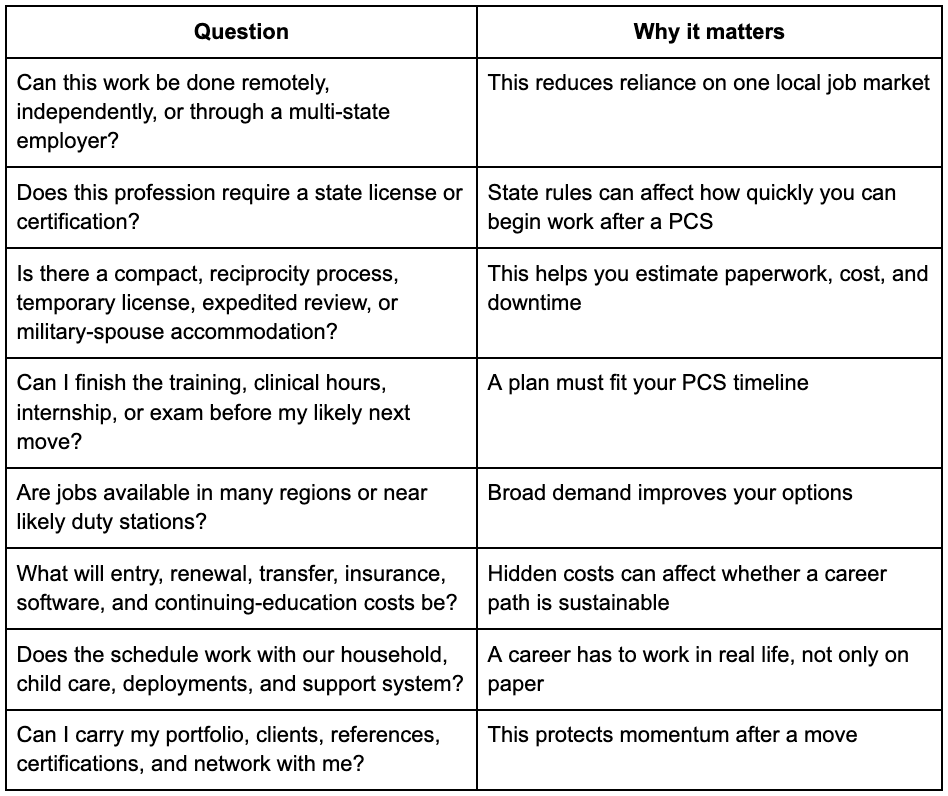
Use the scorecard on three career paths you are considering. The goal is not to find a “perfect” career. It is to identify the path with the strongest fit for your skills, family needs, financial situation, and likely mobility.
Career Paths With Portability Potential
Healthcare and Nursing
Healthcare can be a strong option for military spouses because communities across the country need trained professionals. The U.S. Bureau of Labor Statistics projects registered nurse employment to grow 6 percent from 2025 to 2035, faster than the average for all occupations. Hiring conditions still vary by specialty, license, local market, and employer, but healthcare remains an important field to explore for long-term demand.
Registered nursing can offer hospital, clinic, telehealth, case-management, education, and travel-based opportunities. Depending on your specialty and employer, some roles may provide more predictable schedules or remote options than others.
Other healthcare-related paths to research include:
- Medical coding and billing
- Health information management
- Health informatics
- Medical administration
- Pharmacy technician roles
- Occupational therapy
- Physical therapy
- Behavioral-health support roles
- Clinical research coordination
Check licensing before you invest
Healthcare careers often require state licensure, supervised clinical work, examinations, and continuing education. That does not make them a poor choice for military spouses—it means you should research portability before starting.
Before enrolling, check:
- Your current state licensing board
- The licensing board in your likely next state
- Whether your profession participates in an interstate compact
- Whether the new state offers temporary, expedited, or military-spouse licensing options
- Whether your service branch may reimburse eligible license-transfer costs after a PCS
Federal guidance explains that military spouses may have additional professional-license portability protections under the Servicemembers Civil Relief Act in qualifying PCS circumstances. However, requirements and exceptions can apply, including for professions covered by interstate compacts. Confirm your specific situation with the receiving state’s licensing authority before relying on a transfer pathway.
Writing, Communications, and Liberal-Arts-Based Careers
A liberal arts degree or communications background can become highly portable when you pair it with a visible portfolio, relevant tools, and results you can explain clearly.
Skills that tend to transfer well include:
- Writing and editing
- Research and analysis
- Project management
- Internal communications
- Public relations
- Content strategy
- Training and facilitation
- Information management
- Social media and community management
- Grant writing
- Program coordination
- Human resources support
These skills can lead to work in nonprofit organizations, government contractors, schools, health systems, small businesses, agencies, higher education, and remote-first companies.
Potential roles include:
- Technical writer
- Content writer or editor
- Communications specialist
- Public affairs coordinator
- Human resources coordinator
- Learning and development specialist
- Proposal writer
- Program manager
- Grant writer
- Training coordinator
- Community manager
A degree alone rarely tells the whole story. Portability improves when you can show your work. Build writing samples, project plans, training materials, campaign examples, presentations, or case studies that travel with you.
Remote Employment
Remote work can make career continuity easier, but “remote” does not automatically mean “work from anywhere.”
Before accepting or keeping a remote position through a PCS, ask:
- Can the company legally employ me in my new state?
- Does the company have payroll and tax capability there?
- Are there location restrictions because of contracts, client requirements, security clearances, or state regulations?
- Can I work from an overseas location if we receive OCONUS orders?
- Will my pay, benefits, schedule, or job classification change after the move?
- Does the company require employees to live within a certain distance of an office?
- What happens if the company changes its remote-work policy?
Remote-capable fields may include:
- Project coordination and project management
- Customer success and account support
- Software development
- Cybersecurity
- IT support
- Data analysis
- UX or product design
- Graphic design
- Instructional design
- Online education and tutoring
- Bookkeeping
- Tax preparation
- Financial operations
- Marketing
- SEO
- Copywriting
- Social media management
Availability varies widely by role, experience level, employer, schedule, and security requirements. The best research tool is a review of actual current job postings in the field you want to enter. Generally, job search parameters include a field designating “remote” opportunities. Post-COVID, many more employers are offering remote work, so this is definitely an option to explore thoroughly.
Independent Contracting and Self-Employment
Independent work can be one of the most flexible ways to protect income through a PCS. If you serve clients beyond one local community, you may be able to keep some or all of that work when you move.
Common contractor-friendly areas include:
- Bookkeeping
- Virtual assistance
- Copywriting and editing
- Graphic design
- Social media management
- Digital marketing
- Website support
- Photography and video editing
- Online tutoring
- Curriculum development
- Instructional design
- Consulting
- Event support
- Project management
- Tax preparation
But contracting is not a universal fix. Before relying on independent work, plan for:
- State and local business-registration requirements
- Taxes and bookkeeping
- Business insurance
- Professional licensing rules
- Client contracts
- Time zones
- Child care and work boundaries
- Overseas moves
- A client base broad enough that losing one account does not threaten your income
The goal is to build a business that travels—not one that depends entirely on a single local client, referral source, or installation community.
Portable Career Comparison Guide
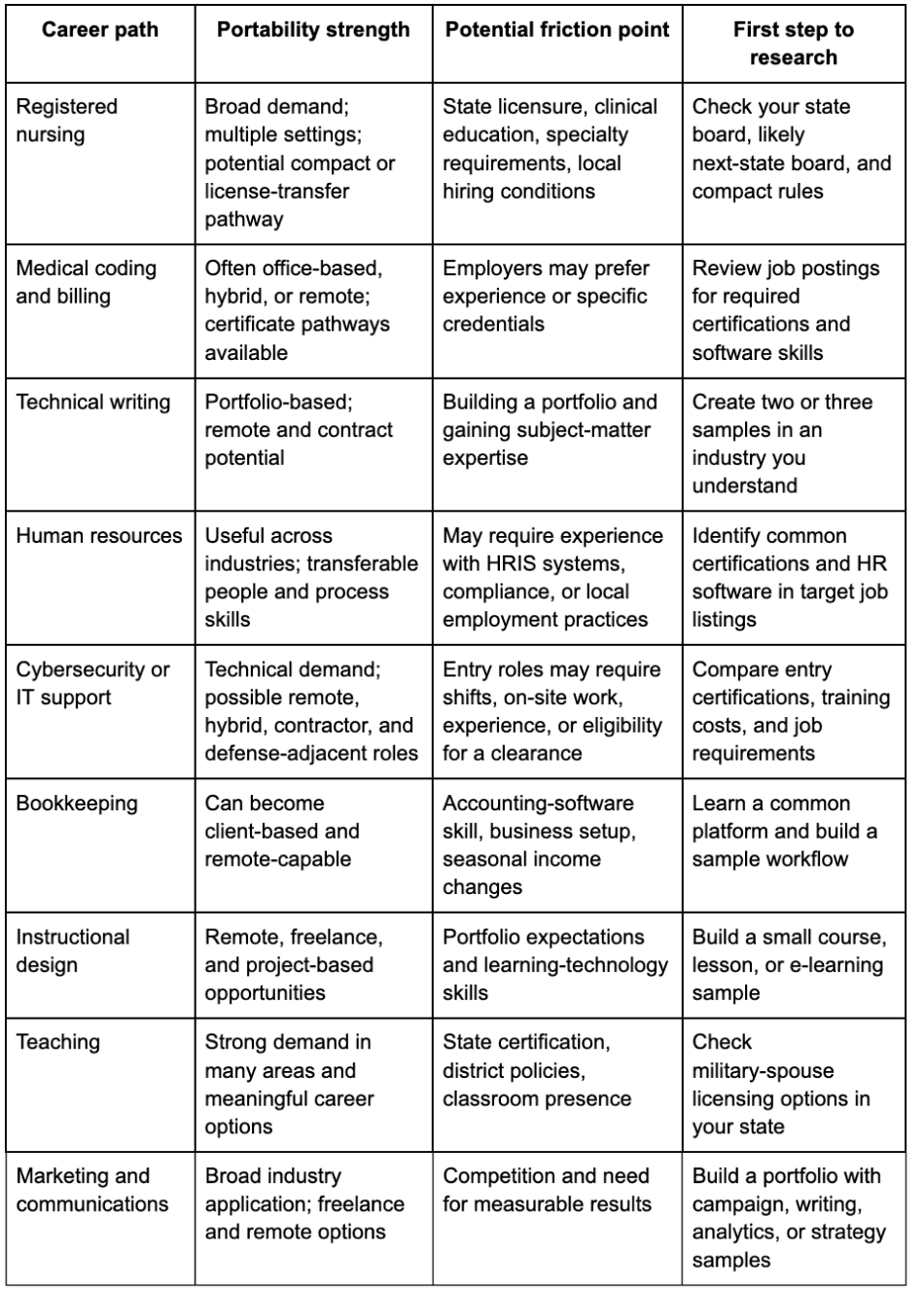
This table is a starting point, not a guarantee. Your education, experience, schedule, duty location, financial goals, and desired work environment should guide your decision.
Funding and Support for Military Spouses
SpouseWorks Scholarship, Formerly MyCAA
The SpouseWorks Scholarship, formerly known as the MyCAA Scholarship, may provide eligible military spouses with up to $4,000 in financial assistance for approved licenses, certifications, associate degrees, and eligible continuing-education courses connected to maintaining a license or certification. Eligibility rules and approved training requirements apply.
Before you enroll in a program:
- Verify your eligibility through the official Military OneSource portal
- Create a career plan if required
- Confirm that the school or program is approved
- Understand the total cost beyond what funding covers
- Confirm that the credential is recognized by employers and, when relevant, state licensing boards
Military OneSource Career Support
Military OneSource can help spouses explore education and employment resources, career coaching, scholarship eligibility, and professional-license transfer information. Spouses can register online or call Military OneSource at 800-342-9647 for support.
Professional License Transfer Resources
The U.S. Department of Labor’s military-spouse license-recognition resources explain that licensing requirements differ by state and direct readers to the CareerOneStop License Finder for state-specific occupational-license information.
Military OneSource also provides guidance on transferring professional licenses and notes that service branches may reimburse eligible spouses up to $1,000 for certain license or certification transfer expenses connected to a PCS move across state lines. Confirm your branch’s current process and eligibility before making plans around reimbursement.

A 90-Day Portable Career Plan
You do not have to make a life-changing decision all at once. Use the next 90 days to replace uncertainty with information and momentum.
Days 1–14: Choose a direction
- List your previous jobs, education, volunteer work, strengths, and responsibilities
- Identify three career paths that interest you
- Complete the portability scorecard for each option
- Review actual job postings to identify required skills, certifications, software, and experience
- Choose one path to research more deeply
Days 15–30: Verify the real requirements
- Check licensing rules, compacts, reciprocity, and military-spouse accommodations if your field requires a license
- Estimate tuition, certification exams, clinical hours, supplies, renewals, insurance, and transfer costs
- Check SpouseWorks Scholarship eligibility and approved training options
- Speak with a Military OneSource career coach, professional association, licensing board, or person working in the field
- Decide whether a degree, certificate, short course, portfolio project, or job-search strategy is the right next move
Days 31–60: Build evidence of your skills
- Update your résumé and LinkedIn profile
- Create a portfolio, certification plan, or project that shows what you can do
- Complete one relevant course, project, or training milestone
- Join a professional community or military-spouse career network
- Schedule one informational interview with someone already working in your target field
Days 61–90: Build career continuity
- Apply for positions, contract opportunities, internships, or volunteer projects that create relevant experience
- Create a secure PCS-ready career folder with transcripts, licenses, certifications, work samples, performance notes, references, and professional contacts
- Build a list of target employers with multi-state, remote, or military-spouse-friendly hiring practices
- Develop a backup plan for the next PCS: likely licensing requirements, remote-work questions, local job leads, and client-retention steps
Frequently Asked Questions
What is the most portable career for a military spouse?
There is no single best career for every military spouse. The strongest choice is one that matches your skills, training capacity, household needs, and mobility requirements. Careers tend to be more portable when they have broad demand, a realistic licensing-transfer pathway, remote or contract options, or employers with multi-state operations.
Can a military spouse transfer a professional license after a PCS?
Often, yes, but the process depends on the profession and destination state. Some occupations have interstate compacts, reciprocity agreements, temporary licenses, expedited reviews, military-spouse accommodations, or qualifying federal license-portability protections. Check with the receiving state’s licensing authority before you move or pay for training.
Does a remote job automatically continue after a PCS?
No. Ask your employer whether it can employ you in the new state, whether your role has location restrictions, and how payroll, taxes, benefits, security requirements, and overseas moves could affect your employment. A role advertised as remote may still be limited to certain states or locations.
What can the SpouseWorks Scholarship pay for?
The SpouseWorks Scholarship, formerly MyCAA, may provide eligible spouses with up to $4,000 toward approved licenses, certifications, associate degrees, and eligible continuing education. Confirm your eligibility, career plan requirements, and approved program status through Military OneSource before enrolling.
Should I choose a degree, certificate, or short-term training?
Start with the job you want, not the credential you think you are supposed to earn. Review current job postings, identify the minimum education and skills employers request, and calculate the full cost and timeline. A short credential may be enough for one role, while another profession may require a degree, supervised practice, or state licensing.
Your Career Can Move With You
A PCS can change your zip code, but it does not have to erase your professional goals. The most resilient career plans combine practical skills, verified credential pathways, a visible record of your work, and a realistic understanding of what your household can support right now.
Start where you are. Choose one career direction, research the actual requirements, and take one next step that strengthens your future options.
What part of building a portable career feels hardest right now: choosing training, transferring a license, finding remote work, managing child care, launching a business, or restarting after a PCS? Share your answer in the comments so we can build the next resource around the support military spouses need most.
Looking for more? Check out these related articles to get your portable career moving in the right direction:
https://mymilitarylifestyle.com/article/teacher-life
https://mymilitarylifestyle.com/article/pick-back-up-where-you-left-off
A Note on Accuracy: We work hard to provide accurate, useful information for military members, veterans, and their families. Still, military life is nuanced, individual circumstances differ, and policies can change. If you notice an error or information that needs updating, please let us know. We appreciate your help in keeping My Military Lifestyle as useful and reliable as possible.







No comments yet. Be the first!