

If you have spent any time around Marines, you have heard it: Semper Fi. It is a greeting, a goodbye, and a promise all at once. Here is what it means, where it came from, and how Marines use it today.
What Does Semper Fi Mean and Why Do Marines Say It?
Semper Fi means "Always Faithful."
It is short for Semper Fidelis, the official motto of the United States Marine Corps, and Marines use it as a greeting, a sign-off, and a promise that does not end when the uniform comes off.
If you have heard a Marine say it and were not sure how to answer, you are in good company.
Marine spouses, parents, and new recruits' families ask the same question every graduation season.
Table of ContentsWhat Does Semper Fi Mean?
- What Does Semper Fi Mean?
- Where Did the Marine Corps Motto Come From?
- How Do Marines Use Semper Fi in Everyday Life?
- Can Civilians Say Semper Fi?
- How Does Semper Fidelis Compare to Other Military Branch Mottos?
- How Is Semper Fidelis Part of Marine Corps Music and Tradition?
- How Can My Military Lifestyle Help Marines and Military Families?
- Frequently Asked Questions About Semper Fi
Key Takeaways
- Meaning: Semper Fi is short for the Latin phrase Semper Fidelis, which translates to "Always Faithful."
- Origin: The Marine Corps adopted Semper Fidelis as its official motto around 1883, while Colonel Charles McCawley was Commandant. No record explains why they chose it.
- How to respond: When a Marine says "Semper Fi," the standard reply is "Semper Fi" right back. Marines often add an "Oorah."
- Civilians: Family members and supporters can say it with respect, such as returning a greeting or congratulating a new Marine, but should never use it to suggest they served.
- Other branches: The Coast Guard (Semper Paratus) and the Space Force (Semper Supra) also have mottos that start with Semper, but Semper Fi belongs to the Marines.
What Does Semper Fi Mean?
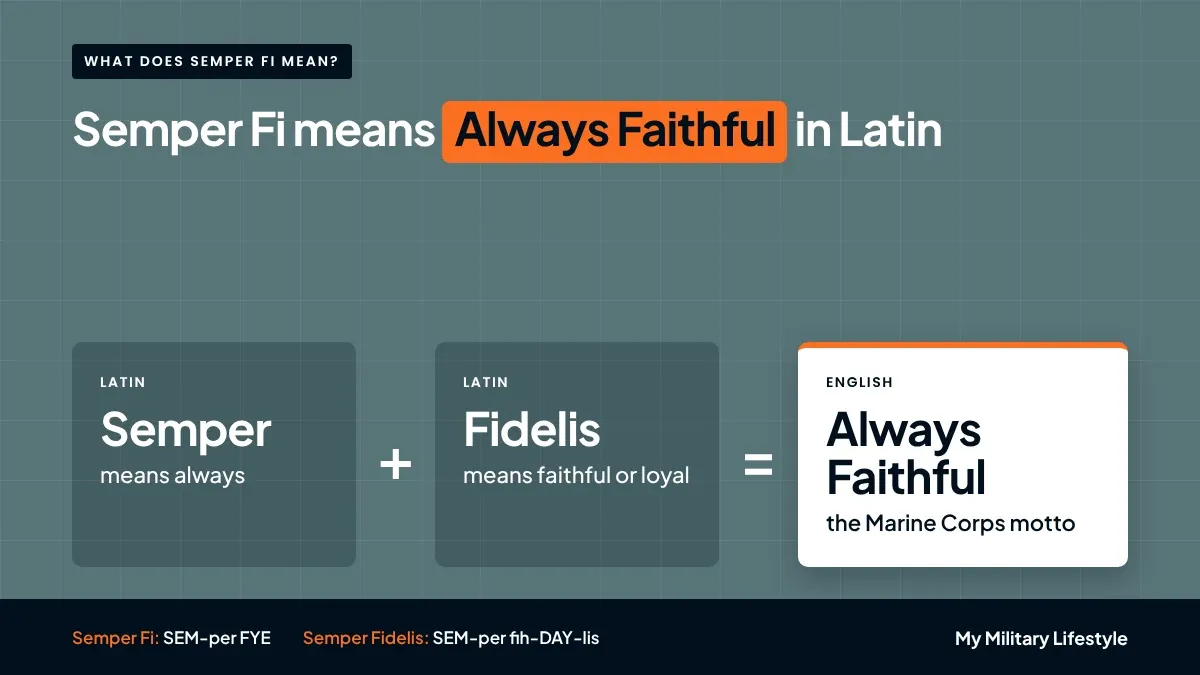
The meaning of Semper Fi comes from Latin: Semper Fi is the shortened form of Semper Fidelis, a phrase that means "Always Faithful."
Semper means "always."
Fidelis means "faithful" or "loyal."
What Does Semper Fi Mean in English, Word for Word?
You already know the root of fidelis.
It is the same root behind English words like fidelity, confide, and confident, all of which come back to trust.
Put the two words together, and the direct translation of Semper Fi is simple: always faithful, always loyal, always someone you can count on.
Saying it right is easy:
- Semper Fi: SEM-per FYE. The "Fi" rhymes with "fly," not "fee."
- Semper Fidelis: SEM-per fih-DAY-lis.
So why does a short Latin phrase carry so much weight?
Because to Marines, it is not a slogan.
It describes how they are expected to live, on duty and off.
Ask Marines what "always faithful" means, and you will hear the same answer in different words: faithful to the mission, to the Corps, to the country, and above all to the Marines on their left and right- an unbreakable bond that outlasts any enlistment.
How Does Semper Fi Connect to the Marine Corps Core Values?
The motto is the promise.
The Marine Corps core values of honor, courage, and commitment are how Marines keep it.
- Honor: Doing the right thing when no one is watching. Being faithful starts with being trustworthy.
- Courage: Moral and physical courage to face fear, danger, and hard calls. Staying faithful to the Marine next to you sometimes means going first.
- Commitment: Dedication to the Corps, the mission, and fellow Marines that does not quit when things get hard. This is the "always" in Always Faithful.
Why Is There No Such Thing as an Ex-Marine?
The "always" in Always Faithful is meant literally.
Marines live by the saying "once a Marine, always a Marine," and most of them bristle at the term "ex-Marine."
These are the terms Marines actually use:
- Active duty Marine: Currently serving full-time.
- Reserve Marine: Serving in the Marine Corps Reserve.
- Veteran or former Marine: Completed their service and separated.
- Retired Marine: Retired from the Marine Corps.
Many Marines reserve "ex-Marine" for someone who left under conditions other than honorable, so the word can land as an insult even when nobody means it that way.
That is why Semper Fi follows Marines long after they hit EAS (end of active service).
Two Marines who got out decades ago will still trade a "Semper Fi" in a hardware store parking lot.
My Military Lifestyle
Once a Marine, always a Marine. Families learn that promise one new word at a time.
My Military Lifestyle explains Marine Corps terms, ranks, and traditions in plain language. Start with Marine Corps ranks in order, and sign up for free members-only guides written for military families.
Knowing what the phrase means is half the story.
The other half is how the Marine Corps landed on it after more than a century of unofficial mottos.
Where Did the Marine Corps Motto Come From?
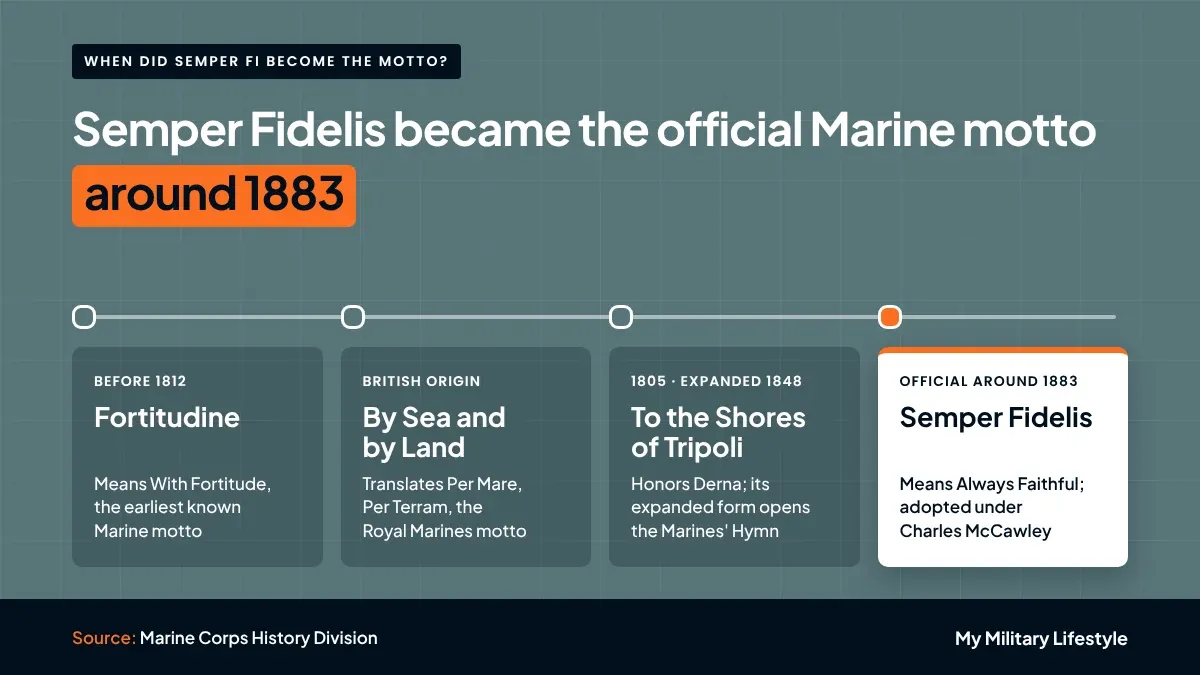
The Marine Corps adopted Semper Fidelis as its official motto around 1883, during the tenure of Colonel Charles McCawley, who served as the 8th Commandant of the Marine Corps from 1876 to 1891.
Before that, Marines carried other traditional mottos, but none were official.
What Mottos Did Marines Use Before Semper Fidelis?
The Continental Congress authorized two battalions of Continental Marines on November 10, 1775, and recruiting famously began at Tun Tavern in Philadelphia.
Marines still celebrate that date every year as the Marine Corps Birthday.
According to the Marine Corps History Division, these traditional mottos came first:
- Fortitudine ("With Fortitude"): The earliest known Marine motto, in use before the War of 1812.
- By Sea and by Land: A translation of Per Mare, Per Terram, the motto of the British Royal Marines, and a nod to the Corps' amphibious role.
- To the Shores of Tripoli: Honoring First Lieutenant Presley O'Bannon and the Marines who helped capture Derna in 1805 during the First Barbary War. After Marines helped take Mexico City in 1847, the motto was expanded in 1848 to "From the Halls of the Montezumas to the Shores of Tripoli."
That expanded line probably sounds familiar.
It became the opening of the Marines' Hymn.
Why Did the Marine Corps Choose Semper Fidelis?
Here is the honest answer most guides skip: nobody knows for sure.
The Marine Corps History Division has said it hasn't found any records explaining why this motto was adopted.
McCawley is credited with the choice, but he left no known explanation.
We do know the context.
Under McCawley's predecessor, Commandant Jacob Zeilin, the Corps adopted a new emblem loosely modeled on the British Royal Marines' insignia and still used "By Sea and by Land," a translation of their Latin motto, Per Mare, Per Terram.
A common theory is that the Corps wanted its own motto instead of a borrowed one.
That theory is reasonable, but no document confirms it.
The earlier mottos pointed to one battle, one campaign, or a phrase borrowed from the British.
Semper Fidelis described the kind of Marine the Corps expected, regardless of rank, job, or duty station.
Whatever the reason, it stuck.
Did the Marine Corps Invent Semper Fidelis?
No.
Marines made Semper Fidelis famous, but the Latin phrase is not theirs alone.
The Marine Corps History Division notes that the Corps shares its motto with England's Devonshire Regiment, the 11th Foot.
You may also see claims online that Roman legions or senators coined the phrase.
No surviving record supports that, so treat it as legend.
How Did Semper Fidelis End Up on the Eagle, Globe, and Anchor?
The emblem actually came first.
Commandant Jacob Zeilin adopted the Eagle, Globe, and Anchor (EGA) in 1868, years before Semper Fidelis became the motto.
Some later versions of the emblem showed the motto on a scroll in the eagle's beak, but that design did not become official until 1954.
That year, President Dwight D. Eisenhower signed Executive Order 10538, which established the Marine Corps seal with an American bald eagle holding a scroll inscribed "Semper Fidelis."
Each part of the emblem carries its own meaning:
- Eagle: The nation Marines serve and defend.
- Globe: The Corps' readiness to serve anywhere in the world.
- Fouled anchor: The Marine Corps' naval heritage and amphibious roots.
- Scroll: Carries the motto Semper Fidelis.
One detail Marines will catch if you get it wrong: the EGA worn on Marine uniforms and covers omits the scroll.
You will see the scroll on the official emblem and seal.
The history explains why the motto matters.
Day to day, though, Marines rarely say the full Latin phrase at all.
How Do Marines Use Semper Fi in Everyday Life?
Marines use Semper Fi as a greeting, a farewell, a written sign-off, and encouragement.
In normal conversation, they almost never say the full Semper Fidelis.
These are the most common ways you will hear it:
- Greeting: Two Marines crossing paths, on base or in an airport terminal, will often trade a "Semper Fi." "Semper Fi, Marine" is the classic version.
- Farewell: It closes out a conversation the way "take care" would, with a lot more behind it.
- Written sign-off: In emails, texts, and letters, Marines often sign off with "Semper Fi" or the abbreviation "S/F."
- Encouragement: It gets passed down the line during a brutal PT session or a long field op as a reminder that nobody quits on the Marine next to them.
- Short form: Some Marines shorten it even further to just "Semper."
What Do Marines Say in Response to Semper Fi?
The standard response to "Semper Fi" is "Semper Fi."
Marines may add or swap in "Oorah," the Marine Corps spirit cry, but simply returning the phrase is always correct.
If you are not a Marine, a warm "Semper Fi" back or a sincere "Thank you for your service" is a respectful reply.
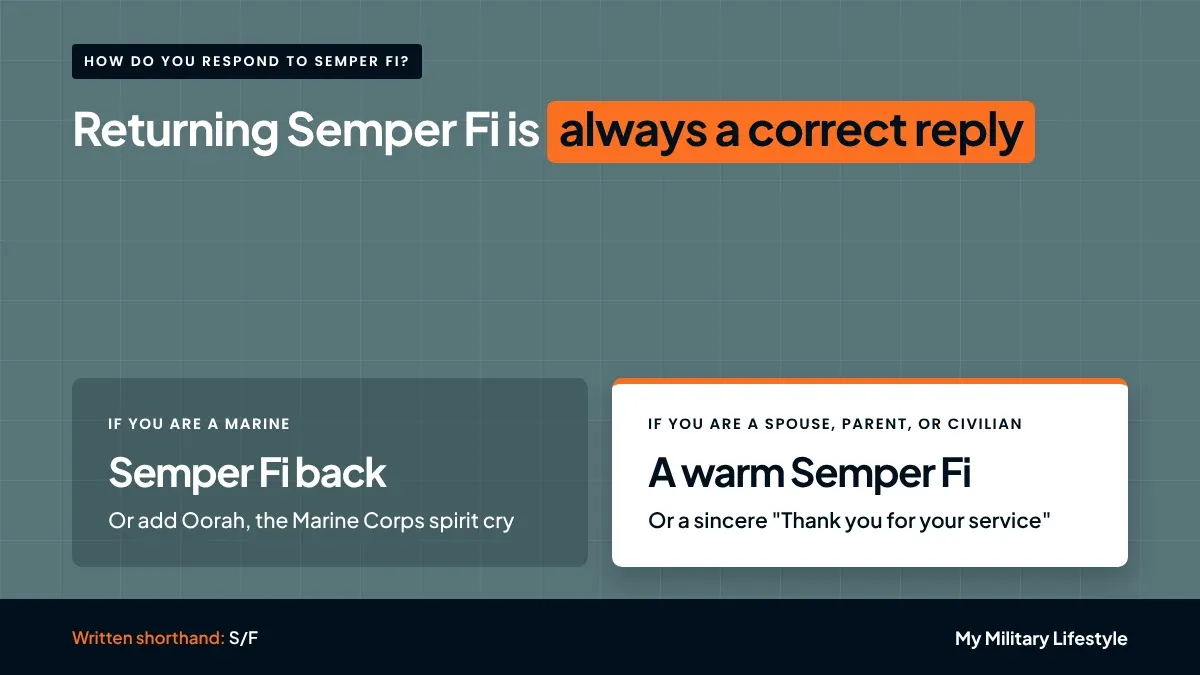
How to respond depends on where you are and who you are:
HOW TO RESPOND TO SEMPER FI
What to say back, by situation
| Situation | If you are a Marine | If you are a spouse, parent, or civilian |
|---|---|---|
| A Marine greets you with "Semper Fi" | "Semper Fi" or "Oorah" | "Semper Fi" or "Thank you for your service" |
| Boot camp graduation | "Semper Fi, Marine" | "Semper Fi" written in a card, or a hug and "We are so proud of you" |
| A text or email signed "S/F" | Sign off "S/F" or "Semper Fi" | Sign back "S/F" or "Semper Fi," or simply say thank you |
| A Marine veteran's funeral or memorial | "Semper Fi" as a final farewell | "Thank you for his service" or "Thank you for her service" |
| You spot a Marine Corps hat or sticker in public | "Semper Fi" or "Oorah" | "Thank you for your service" |
What Do Semper Fi, Do or Die, and Semper Gumby Mean?
Marines have built a whole family of phrases on top of the motto.
You will hear these in barracks, cadences, and group chats.
- Semper Fi, Marine: The classic full greeting between Marines. It recognizes the other person as a fellow Marine.
- Semper Fi, do or die: A rhyming add-on heard in cadences, chants, and reunions. It is enthusiastic and informal.
- Semper Gumby: Mock Latin for "always flexible," named after the bendable clay cartoon character. Marines say it when plans change yet again, which is often in military life. You will also hear it across the other branches.
- Once a Marine, always a Marine: The motto's lifelong promise in plain English.
- S/F: The written shorthand for Semper Fi in emails, texts, and letters.
Can Navy Corpsmen and Chaplains Say Semper Fi?
Navy corpsmen and chaplains who serve with Marine units live, train, and deploy alongside Marines.
Corpsmen fill that role because the Marine Corps does not train its own medical personnel, and Marines usually call their corpsman "Doc" instead of using a rank.
Many Marines consider them family, and you will often hear corpsmen trade a "Semper Fi" with the Marines they served with.
It signals that bond, not a claim to the title of Marine.
How Does a Recruit Earn the Title of Marine?
Recruits are not called Marines until they earn it.
At Marine Corps Recruit Depot Parris Island or San Diego, that moment comes at the end of the Crucible, when recruits receive their Eagle, Globe, and Anchor and are addressed as Marines for the first time.
Officers earn the title through Officer Candidate School.
That is why Semper Fi carries so much emotion for families in the bleachers on graduation day.
Their Marine did not get the phrase.
They earned it.
My Military Lifestyle
Your Marine earned the title. Now your family gets ready for what comes after graduation.
Graduation usually leads to more training and then a first duty station. Sign up for free with My Military Lifestyle for THE PCS Checklist and members-only guides for Marine families, and look up the base your Marine reports to next.
Once you know how much it means to Marines, the next question is obvious: can you say it if you never served?
Can Civilians Say Semper Fi?
Yes.
Civilians, spouses, and family members can say Semper Fi respectfully, especially when returning a Marine's greeting or celebrating a Marine milestone.
It crosses the line to use it as throwaway slang or to suggest you served.
Do:
- Return the greeting: If a Marine says "Semper Fi" to you or your family, it's fine to say it back.
- Celebrate milestones: It fits naturally in letters to a recruit at boot camp and in cards and messages for boot camp graduation, promotions, retirements, and the Marine Corps Birthday.
- Show pride in your Marine: Marine parents and spouses use it all the time, and Marines generally appreciate it.
Don't:
- Use it as filler slang: Tossing it around with friends or in jokey social posts can come across as hollow.
- Imply you served: Claiming service you did not perform is stolen valor territory, and the military community takes it seriously.
- Use it with the wrong branch: Semper Fi belongs to Marines, so greeting a Soldier, Sailor, Airman, Guardian, or Coast Guardsman with it misses the mark.
FREE MEMBERSHIP
Proud of a Marine and Still Learning the Lifestyle?
Knowing when to say Semper Fi is a good start. A free My Military Lifestyle membership helps Marine families with what comes next, from the first set of orders to the next Marine Corps Birthday.
- THE PCS Checklist, members-only and built for the next set of orders
- Members-only guides written for Marine spouses, parents, and families
- A personal feed built around the Marine Corps and your nearest base
How Does Semper Fidelis Compare to Other Military Branch Mottos?
Each branch of the armed forces sets its own motto, and the Marine Corps (Semper Fidelis), the Coast Guard (Semper Paratus), and the Space Force (Semper Supra) all open with the Latin word semper, meaning "always."
The Navy is the outlier, with no official motto at all.
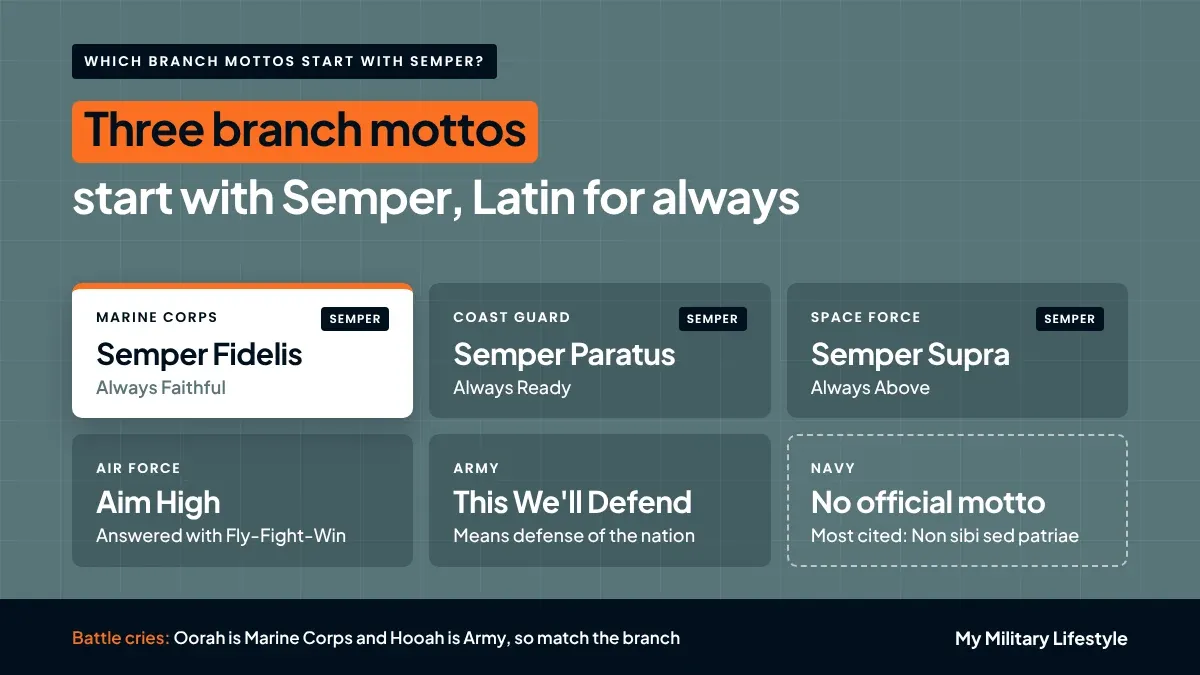
MILITARY BRANCH MOTTOS COMPARED
Every branch motto at a glance
| Branch | Motto | Translation or Meaning | Background |
|---|---|---|---|
| Marine Corps | Semper Fidelis | Always Faithful | Official since about 1883 and carried on the scroll of the Marine Corps emblem |
| Coast Guard | Semper Paratus | Always Ready | A long-time Revenue Cutter Service watchword, first officially recognized in 1910, and the title of the official Coast Guard marching song |
| Space Force | Semper Supra | Always Above | Unveiled with the Space Force logo on July 22, 2020, the year after the Space Force was established |
| Air Force | Aim High, Fly-Fight-Win | A call to action and the answer to it | Announced in October 2010 after input from Airmen of all ranks and career fields |
| Army | This We'll Defend | Defense of the nation | Adopted by the Continental Army's War Office in 1778 and displayed on the Army's official seal |
| Navy | No official motto | Non sibi sed patriae ("Not self but country") is the most cited unofficial motto | "Anchors Aweigh" is the Navy's unofficial service song, not its motto, per the Naval History and Heritage Command |
What Do Semper Paratus and Semper Supra Mean?
- Semper Paratus (Coast Guard): "Always Ready" fits a service that launches search and rescue, maritime law enforcement, and port security missions in any weather, at any hour. Captain Francis Saltus Van Boskerck wrote the words of the "Semper Paratus" song in the cabin of the cutter Yamacraw in 1922, according to the Coast Guard Historian's Office.
- Semper Supra (Space Force): "Always Above" reflects the Space Force mission of protecting U.S. interests in space and the satellites that troops on the ground depend on. The Space Force released the motto with its logo at the Pentagon and says both honor the service's heritage and history.
How Do the Branch Battle Cries Differ?
Mottos are not the only thing that gets mixed up.
Each branch has its own spirit cry, and using the wrong one is a fast way to get corrected.
- Oorah: Marine Corps.
- Hooah: Army.
- Hooyah: Navy.
Want the full story on the Marine cry?
Read our guide on what Oorah means.
My Military Lifestyle
Every branch has its own always, whether it is Always Faithful, Always Ready, or Always Above, and every one of them has a place here.
My Military Lifestyle serves every branch, plus veterans, retirees, Guard, Reserve, and military families. Pick your branch when you sign up free, and your feed fills with guides for the uniform in your family.
How Is Semper Fidelis Part of Marine Corps Music and Tradition?
Semper Fidelis is also the official march of the Marine Corps.
John Philip Sousa composed it in 1888 while he led the United States Marine Band, known as "The President's Own."
The march traces back to President Chester A. Arthur, who disliked the official use of "Hail to the Chief" and asked Sousa for more fitting music.
Sousa finished Semper Fidelis after Arthur's death, dedicated it to the officers and men of the Marine Corps, and regarded it as his best march, musically speaking.
The motto shows up across Marine Corps tradition:
- The Semper Fidelis march: Sousa's march is still performed at Marine Corps ceremonies, parades, and events.
- The Marines' Hymn: Commonly acknowledged as the oldest anthem of the U.S. services, it opens with "From the Halls of Montezuma to the shores of Tripoli," a slightly shortened form of the motto Marines carried in 1848.
- The Marine Corps Birthday: Every November 10, Marines around the world mark the birthday with a cake-cutting ceremony. By tradition, the oldest Marine present passes a piece of cake to the youngest, symbolizing experience handed down to the next generation.
Together, the motto, the emblem, the march, and the birthday traditions tie every generation of Marines to the ones who came before.
Outside of ceremonies, you will spot Semper Fi on tattoos paired with the Eagle, Globe, and Anchor, on challenge coins, and on the headstones of Marines laid to rest.
How Can My Military Lifestyle Help Marines and Military Families?
My Military Lifestyle is a free resource for active duty service members, veterans, retirees, National Guard and Reserve members, and military families.
We verify and organize the information military households actually use, so you don't have to piece it together on your own.
These free resources are open to everyone, no account needed:
- Military discount directory: Verified military discounts organized by brand and category, with eligibility details so you know who qualifies before you claim.
- Military base guides: Housing, schools, medical facilities, and on-base amenities at Marine Corps installations such as Camp Lejeune, Camp Pendleton, and Parris Island, to help you prepare for your next PCS.
- Reference guides: The military rank structure, military pay chart, military time chart, and a military dictionary that decodes the lingo.
Marines spend their careers being always faithful to everyone else.
Let us return the favor.
My Military Lifestyle
From boot camp to decades past EAS, Semper Fi never expires.
Neither does a free My Military Lifestyle membership. Members get THE PCS Checklist for the next set of orders, members-only military discounts claimed through My Military Lifestyle, and guides for every stage of Marine life.
Frequently Asked Questions About Semper Fi
Semper Fi means "Always Faithful" in English. It is the short form of Semper Fidelis, the official motto of the United States Marine Corps.
The Marine Corps adopted Semper Fidelis as its official motto around 1883, while Colonel Charles McCawley was Commandant. The Marine Corps History Division has found no record explaining why it was chosen.
Marines usually respond to "Semper Fi" with "Semper Fi." Many also answer with "Oorah," the Marine Corps spirit cry. Civilians can reply with "Semper Fi" or "Thank you for your service."
S/F is shorthand for Semper Fi. Marines use it to sign off emails, texts, and letters, and family members often use it the same way when writing to their Marine.
Yes. Civilians and military family members can say Semper Fi to return a Marine's greeting, celebrate a Marine milestone, or show support. It should never be used as casual slang or to imply military service.
Usually not as a greeting, because Semper Fi is the Marine Corps motto and every other branch has its own. The common exception is Navy corpsmen and chaplains who served with Marine units, who often trade it with the Marines they served beside.
Marines say Semper Fi because it is the Marine Corps motto and a shared promise of loyalty to the Corps, the country, and fellow Marines. It works as a greeting, a farewell, and a reminder that the bond lasts for life.
Semper Fi is pronounced SEM-per FYE. The full motto, Semper Fidelis, is pronounced SEM-per fih-DAY-lis.
The Marine Corps, the Coast Guard, and the Space Force have official mottos that start with Semper: the Marine Corps' Semper Fidelis ("Always Faithful"), the Coast Guard's Semper Paratus ("Always Ready"), and the Space Force's Semper Supra ("Always Above").
Semper Fi is the Marine Corps motto, and it means "Always Faithful." Oorah is the Marine Corps spirit cry. It has no literal translation and is used to show motivation, agreement, or enthusiasm. Marines often use the two together.
Semper Gumby is military slang for "always flexible." It is a joke on Semper Fidelis, named after the bendable clay cartoon character. Marines and other service members say it when plans change at the last minute.
Semper Fi, do or die is an informal, rhyming add-on to the motto that you will hear in cadences, chants, and Marine reunions. It is not an official motto, and it simply pairs Always Faithful with the idea of giving everything for the mission and the Marines beside you.
John Philip Sousa composed the Semper Fidelis march in 1888 while he was leading the United States Marine Band. It remains the official march of the Marine Corps.
Start with the free military dictionary from My Military Lifestyle, which explains terms like EAS, EGA, and the Crucible in plain language. For guides written for Marine families, create your free My Military Lifestyle account.
Ready to make the most of the benefits you have earned? Join the My Military Lifestyle community.
Create your free accountTerms Used in This Article
A Note on Accuracy
We work hard to give accurate, up-to-date information. Military policies, benefits and traditions change, so check official sources such as marines.mil before making decisions. See something we should fix? Let us know.
No comments yet. Be the first!