


Getting approved for VA disability compensation can feel like the finish line, especially if you've spent months waiting for a decision.
Then you hear about back pay, and suddenly there's another question: How much money should you actually receive?
VA calls it retroactive benefits. It's compensation owed for eligible months before your regular payments begin. Depending on your disability rating and effective date, that could mean hundreds or thousands of dollars.
Here's what matters, how to protect your claim date, and what to check before accepting VA's calculation.
What Is VA Disability Back Pay?

When VA approves a disability claim, it assigns an effective date—the date your entitlement to benefits officially begins.
Your compensation may be owed for months before VA approves the claim. VA generally pays that amount as a lump sum.
However, here’s an important detail in the process (one a lot of people miss):
VA generally doesn't pay compensation for the calendar month in which your effective date falls. Payments begin accruing the following month, and VA pays monthly benefits in arrears.
For example, if your effective date is September 15, your first payable month would generally be October, with that month's regular payment due in November.
So your back pay isn't necessarily your monthly benefit multiplied by every month since you filed.
How Does VA Determine Your Effective Date?
For a typical claim involving a disability caused or worsened by military service, VA generally uses whichever date is later:
- The date VA received your claim.
- The date your entitlement to the benefit arose.
Special rules can establish an earlier date. Three situations are especially worth understanding.
1. Filing Within One Year of Separation
If VA receives your claim within one year after you leave active duty, your effective date may be as early as the day after separation, assuming you met the eligibility requirements then.
Wait longer than a year, and that separation-based rule generally won't apply.
2. Submitting an Intent to File
Not ready to submit your complete claim?
An Intent to File (ITF) can preserve a potential earlier effective date while you gather records.
You generally have one year after submitting the ITF to file your completed claim.
You can submit one through VA.gov, by phone, or using VA Form 21-0966. Starting an online disability application can also automatically establish an ITF.
One important distinction: an ITF doesn't guarantee payment back to that date. Your eligibility and the rules governing your particular claim still matter.
3. Challenging a Previous Decision
If VA denied your claim, don't assume filing another application automatically restores your original effective date.
Requesting a qualifying decision review within the applicable deadline can help preserve that earlier date through what's called continuous pursuit.
Exceptions and special rules apply, so a previously denied claim deserves a closer look before you submit anything new.
You can review the VA's official effective-date rules.
Still on Active Duty? Look Into BDD
If you're preparing to separate, the Benefits Delivery at Discharge (BDD) program is worth knowing about.
BDD allows eligible service members to submit a disability claim before leaving active duty.
To qualify, you generally must:
- Have a known separation date between 180 and 90 days away.
- Be serving on full-time active duty.
- Be available for VA examinations within 45 days after submitting your claim.
- Meet the program's other documentation and eligibility requirements.
For qualifying claims, your effective date may be the day after separation.
BDD is designed to help VA process your claim sooner, but it doesn't guarantee a decision or payment within a particular number of days.
And if you're less than 90 days from separation, you may still be able to file a pre-discharge claim outside the BDD program.
Start with the VA's pre-discharge claim guide.
How Much VA Back Pay Could You Receive?
Let's put some numbers behind this.
Under the current 2026 VA compensation rates, effective December 1, 2025, a veteran with no dependents receives:
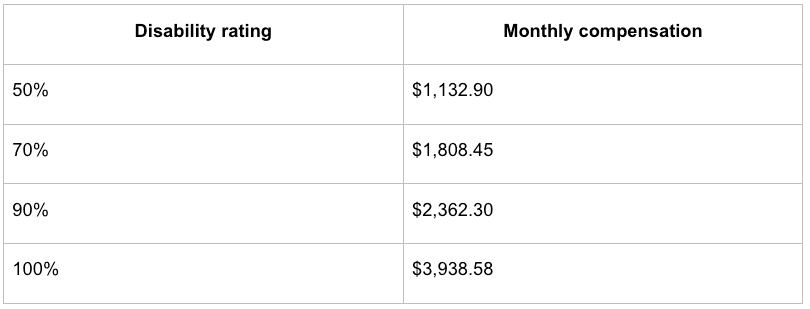
Now imagine you're approved at 70%, have no dependents, and are owed 12 full payable months at the same monthly rate.
That's:
$1,808.45 × 12 = $21,701.40 in estimated back pay.
Not a bad amount to have waiting for you.
But that's an illustration, not a guaranteed payment.
Your actual amount may change based on annual rate increases, dependent status, changes in your rating, previous payments, or required offsets.
If your award covers multiple years, VA generally calculates the applicable rate for each period rather than using today's rate for every past month.
Check the current VA compensation tables before estimating your own payment.
How to Protect Your Back Pay
You don't need to know every VA regulation. But there are a few things I'd make sure you do.
1. Establish your filing date early. If you're not ready to file, consider an Intent to File. If you're approaching separation, check BDD eligibility.
2. Submit useful evidence. Service treatment records, medical reports, and relevant statements can help support your claim. Some cases also need medical evidence connecting the condition to service.
3. Use accredited help when needed. VA-accredited Veterans Service Organization (VSO) representatives can assist for free. Accredited attorneys and claims agents may also help, subject to applicable fee rules.
4. Respond to VA requests. Monitor your claim through VA.gov and attend scheduled Compensation and Pension (C&P) examinations. If you can't attend, contact VA promptly to request another appointment. Missing an exam can hurt your claim, but it doesn't automatically erase your effective date.
5. Read your decision letter. Check the disability rating, effective date, and payment information. Don't assume they're correct just because the claim was approved.
What If VA Gets Your Effective Date Wrong?
You can challenge the decision.
For most disability compensation decisions, you have three review options:
- Higher-Level Review: Ask a senior reviewer to reconsider the decision using the existing evidence.
- Supplemental Claim: Submit or identify new and relevant evidence.
- Board Appeal: Request review by a Veterans Law Judge.
For most claims, requesting the appropriate review within one year of the decision letter is important for preserving the possibility of an earlier effective date.
You can submit a Supplemental Claim after one year, but doing so generally won't preserve the original date through continuous pursuit. Exceptions may apply.
If you're unsure which option fits your situation, speak with an accredited representative before filing.
See the VA decision-review options.
Is VA Disability Back Pay Taxable?
No. VA disability compensation, including retroactive payments, is generally exempt from federal income tax.
However, the amount you actually receive may be affected by military retired pay, separation or disability severance pay recoupment, or other applicable offsets.
Military retirees should pay particular attention to the rules governing Concurrent Retirement and Disability Pay (CRDP) and Combat-Related Special Compensation (CRSC).
The Bottom Line
VA disability back pay isn't a bonus. It's compensation you're legally entitled to receive for eligible past months.
And the date VA assigns to your claim can make a substantial difference in what you're owed.
My advice is simple: file early, keep your records, and read your decision letter carefully.
If something doesn't look right, ask questions before the review deadline passes. A free VA-accredited VSO representative can be a good place to start.
You earned these benefits through your service. Make sure you understand what VA has awarded you—and why.
Disclaimer: This article provides general educational information, not individualized legal or financial advice; consult a qualified VA-accredited representative or professional about your specific claim.










No comments yet. Be the first!