


A veteran health identification card (VHIC) is the free photo ID the Department of Veterans Affairs issues to veterans enrolled in VA health care.
You use it to check in at VA appointments, to prove veteran status for discounts, and, if your card carries the right designation, to shop at the commissary and exchange.
Plenty of veterans have one sitting in a wallet and only ever show it at the front desk of a VA clinic.
That is a lot of value left on the table.
This guide walks through who qualifies, how to request the card online or in person, what the printed designations unlock, and how to get through the gate on your first base visit.
Key Takeaways
- Enrollment comes first: VA issues the VHIC only after you are enrolled in VA health care, and the card itself is free.
- A disability rating is not required to get the card, although a service-connected rating is what opens in-person commissary and exchange shopping.
- You can request the card one time, either online through AccessVA or in person with the enrollment coordinator at a VA medical center.
- The words printed under your photo matter, because the commissary, exchange, and base gate look for designations such as Service Connected, Purple Heart, Former POW, or Medal of Honor.
- The VHIC is not insurance, does not pay copays, and does not authorize care outside VA, but TSA accepts it as identification at airport checkpoints.
- Every honorably discharged veteran can shop the military exchanges online, even without a VHIC.
In This Guide
- What Is a Veteran Health Identification Card?
- VHIC Eligibility: Who Can Get the Card
- How to Get a VA ID Card Online or in Person
- What You Can Use Your VHIC For
- Can Veterans Shop at the Commissary With a VHIC?
- Veteran ID Card vs VHIC: Which Card Do You Need?
- How to Replace, Renew, or Update Your VHIC
- Common VHIC Mistakes That Slow Veterans Down
- How My Military Lifestyle Helps Veterans Put Their VHIC to Work
- Frequently Asked Questions About the Veteran Health Identification Card
- Terms Used in This Article
- Keep Reading
What Is a Veteran Health Identification Card?
A veteran health identification card is a secure photo ID that VA mails to veterans enrolled in VA health care.
It confirms your identity when you check in at VA medical centers and clinics, proves veteran status for retail discounts, and, when it shows a qualifying designation, serves as your credential for commissary, exchange, and MWR privileges on military installations.
Think of it as the card that ties your face to your VA health record.
The member ID printed on the front is a unique identifier, not your Social Security number, so the card is safer to hand across a counter than the older VA cards it replaced.
If you still have one of those older cards, VA asks you to cut it up or shred it.
What does a VHIC look like?
The front shows your photo, your name, your member ID, and the emblem of your most recent branch of service.
Space is tight, so the card displays only one branch emblem even if you served in more than one.
Below your photo you may see a designation such as SERVICE CONNECTED, PURPLE HEART, FORMER POW, or MEDAL OF HONOR, depending on what the VA enrollment system has on file for you.
The letters "VA" are printed in braille so veterans with low vision can find the card by touch, and an expiration date is printed on the card.
Is the VA health care ID card the same as health insurance?
The VA health care ID card is an identification credential, not an insurance card or a payment card.
It does not cover copays, and it does not authorize care at a civilian hospital or clinic.
Community care and any copays are decided separately through your VA enrollment and referrals, and you can still receive VA care on a day the card is sitting at home, because staff can confirm who you are in other ways.
VHIC Eligibility: Who Can Get the Card
The one firm requirement for a VHIC is enrollment in VA health care.
If VA has enrolled you and you have received your welcome call, you can request the card.
That means the real eligibility question is whether you qualify for VA health care, and more veterans do than most people assume.
Do you need a disability rating to get a VHIC?
You do not need a disability rating to get the card.
Many veterans with no service-connected rating at all qualify for VA health care based on their service, their discharge, their income, a qualifying exposure, or a special status such as Purple Heart recipient or former prisoner of war.
In general, VA looks at whether you served on active duty, whether your discharge was other than dishonorable, and whether you meet any minimum service rules that apply to the era you served in.
National Guard and Reserve members can qualify when they were called to federal active duty for purposes other than training.
How VA decides your place in line
After you apply, VA places you in a priority group.
Your priority group affects what you may owe for some care and prescriptions, but it does not change whether you can get the card.
The fastest way to find out where you stand is the official VA health care eligibility page, and you can apply for VA health care online in one sitting.
If your application is complicated by a discharge upgrade or an older claim, a free VA accredited representative can help you sort it out before you request the card.
How to Get a VA ID Card Online or in Person
Once your enrollment is confirmed, getting a VA ID card takes four steps:
- Confirm enrollment: wait for your VA health care welcome call, which tells you VA has finished enrolling you.
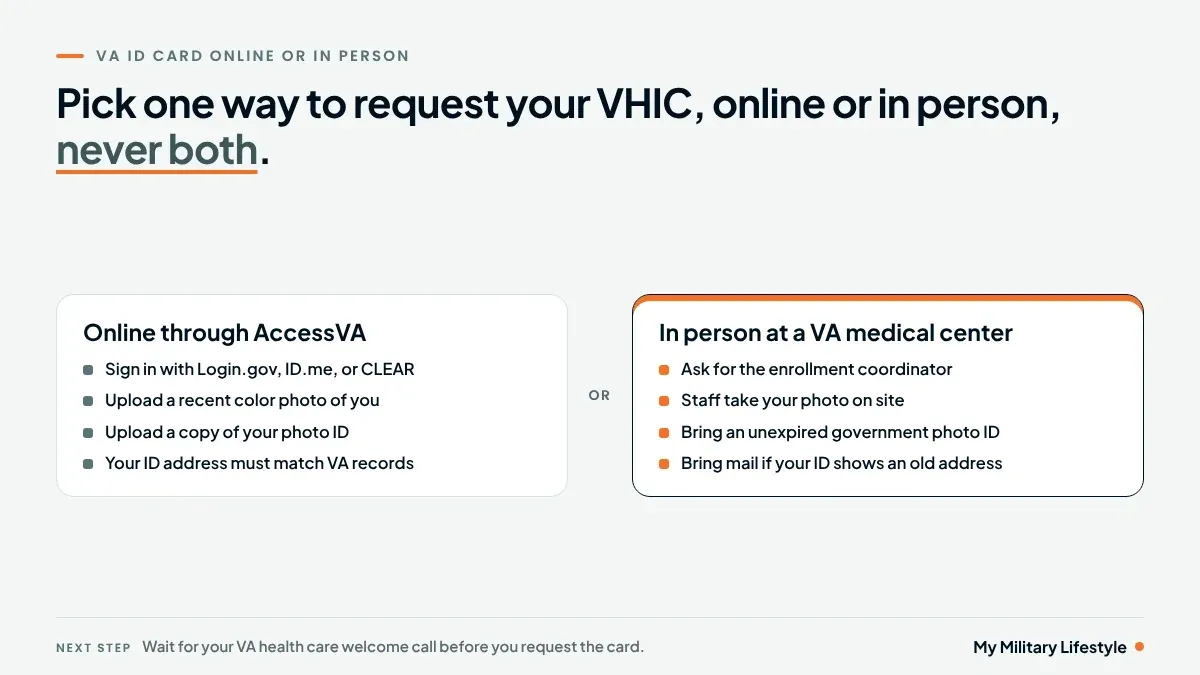
- Choose one method: request the card online through AccessVA or in person through the enrollment coordinator at a VA medical center, but never both.
- Gather your ID and photo: have a current, unexpired government photo ID ready, plus a qualifying photo if you apply online.
- Watch the mail: VA prints and mails the card to the address it has on file.
Request your VHIC online through AccessVA
Open the AccessVA VHIC request page and sign in with a Login.gov, ID.me, or CLEAR account, or with a Department of Defense CAC or PIV card.
The online form asks for two uploads: a recent color picture of you and an image of your unexpired photo ID.
Before you start, check that the address on your ID matches the address VA has on file, because a mismatch stops an online request cold.
You can fix that first by updating your address in your VA.gov profile.
Veterans living overseas who do not already have one of those sign-in accounts will need to verify their identity through ID.me.
Request your VHIC in person through a VA medical center
Find your nearest VA medical center and ask for the enrollment coordinator, who can schedule your photo.
You can also ask about the card at your next VA appointment and get the picture taken while you are already in the building.
Bring a current state driver's license, a U.S. passport, or another federal, state, or local government photo ID that shows your name, address, and date of birth.
If your ID does not show your current address, bring a piece of mail such as a utility bill or voter registration card to prove it.
| Requirement | Online through AccessVA | In person at a VA medical center |
|---|---|---|
| VA health care enrollment | Required | Required |
| Sign-in account | Login.gov, ID.me, CLEAR, or DoD CAC or PIV card | Not applicable |
| Photo ID | Upload a copy of a current, unexpired government photo ID | Bring a current, unexpired government photo ID |
| Proof of address | Address on your ID must match VA records | Bring mail showing your address if your ID does not |
| Photo of you | Digital color photo you upload | Taken on site by VA staff |
| Photo rules | Taken within the last 6 months, light background, full front view, no eyeglasses, neutral expression with mouth closed, square crop from the shoulders up | Not applicable |
| Accepted photo file types | .jpeg, .png, .bmp, .gif, or .tiff | Not applicable |
| How many requests to submit | One | One |
| Situation | What to expect | What to do if it runs late |
|---|---|---|
| Card mailed to a U.S. address | Within 7 to 14 days | Call the VA medical center that took your photo after 10 days, or your nearest VA medical center after 10 business days for an online request |
| Card mailed to an address outside the U.S. | Within 30 business days | Contact the VA Foreign Medical Program office |
| Card nearing its expiration date | You can request a new card within 1 year of the printed expiration date | Request a replacement online, by phone, or in person |
| Installation enrollment for commissary, exchange, and MWR access | Typically valid for one to three years, or one year after your last visit to that installation, and it ends when your card expires | Stop at that installation's visitor center to re-enroll |
| Questions about a missing card | VA health benefits line at 877-222-8387 (TTY 711) | Ask the VA health benefits team or your enrollment coordinator to check your request status |
Waiting on your VHIC to show up in the mailbox?
Use the wait to line up everything the card unlocks.
A free My Military Lifestyle account sets your feed to your branch and the installation nearest you, and new guides on VA health care and veteran benefits land in your inbox as we publish them.
What You Can Use Your VHIC For
The card does more than most veterans realize, but each use has its own rules.
Checking in at VA health care appointments
This is the card's official job.
Show it at check-in, and at some facilities you can scan it at a self-service kiosk to move faster.
It links staff straight to your VA health record without you reciting your Social Security number in a crowded waiting room.
Proving veteran status for discounts
VA itself says that if you have a VHIC, you do not need another photo ID to prove you are a veteran for retail or business discounts.
Restaurants, hotels, retailers, and service companies that offer veteran pricing generally accept it, although every discount is voluntary and every business sets its own terms.
Before you head to the register, browse the free My Military Lifestyle military discount directory to see which brands offer veteran pricing and how to claim it.
Popular starting points include restaurant discounts and travel and hotel deals.
Getting through airport security
TSA lists the Veteran Health Identification Card among the acceptable IDs at TSA checkpoints, so you can use it to fly within the United States.
It is still smart to carry a backup ID in case a screener is unfamiliar with it.
What the card cannot do
It cannot pay a copay, act as a credit card, or authorize care at a non-VA facility.
It does not replace a Department of Defense ID for retirees or for veterans who already hold one.
It does not, on its own, get every veteran onto a military base, which is the part of the story that trips up the most people.
Carrying a VHIC but still paying full price?
Your card proves you served, and that is all most veteran discounts ask for.
The public directory shows which brands honor veteran status, and a free account adds members-only discounts you claim through My Military Lifestyle.
Open my free veteran account or Search veteran discounts by category
Can Veterans Shop at the Commissary With a VHIC?
Yes, if your VHIC shows a qualifying designation.
The Department of Defense expanded in-person commissary, exchange, and MWR retail privileges under the Purple Heart and Disabled Veterans Equal Access Act, and the VHIC became the credential that proves you qualify.
Military retirees, Medal of Honor recipients, and veterans with a 100 percent service-connected rating already had privileges through a DoD ID, so the expansion mainly helps everyone else with a qualifying status.
Who qualifies for in-person commissary, exchange, and MWR privileges
You qualify for in-store shopping if you are a veteran with a service-connected disability rating at any level, even a noncompensable rating that pays no monthly compensation.
Purple Heart recipients, former prisoners of war, and Medal of Honor recipients also qualify.
The primary family caregiver of an eligible veteran, approved under VA's Program of Comprehensive Assistance for Family Caregivers, qualifies too.
Enrollment in VA health care alone, without one of those statuses, does not open in-store shopping.
The law behind these privileges does not add a separate discharge test, because the qualifying status itself, such as a VA service-connected rating, is what the visitor center and the register verify.
You can confirm the current list on VA's commissary and exchange privileges page and on the Defense Commissary Agency's commissary shopping eligibility page.
How to get on base the first time
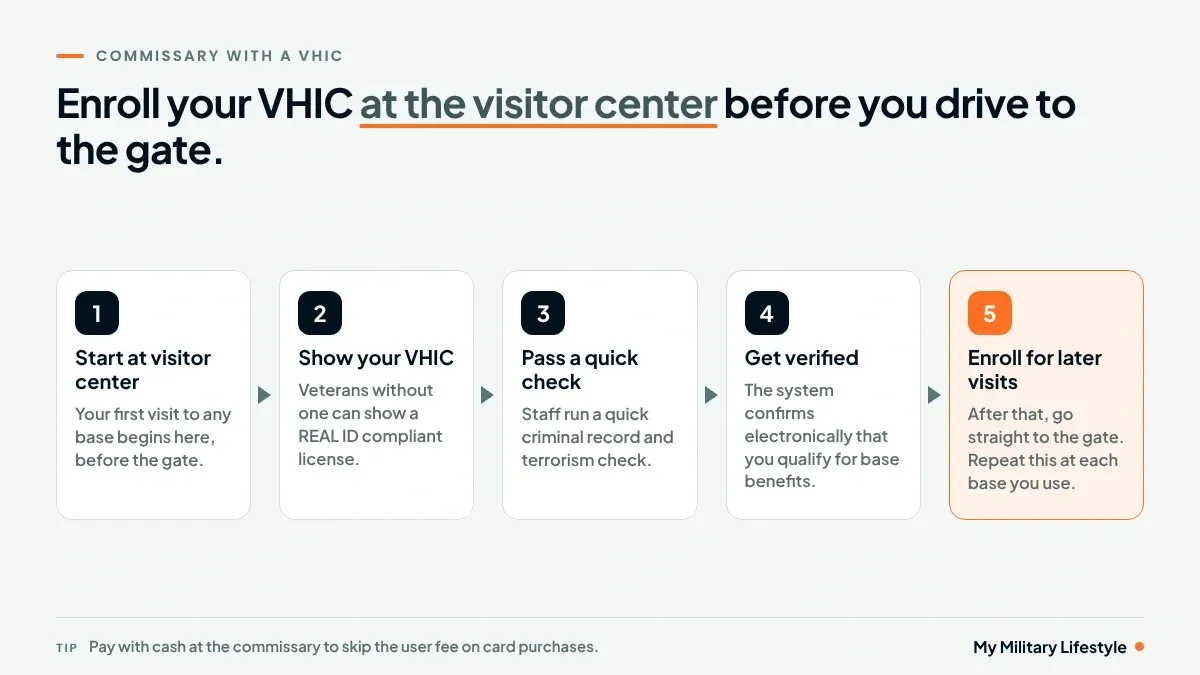
Your first visit to each installation starts at the visitor center, not the gate.
- Present your credential: show your VHIC, or a REAL ID-compliant license if you do not have a VHIC, to establish identity.
- Pass a quick background check: staff run an on-the-spot criminal record and terrorism check.
- Get your eligibility verified: the system confirms electronically that you qualify for on-base benefits.
- Enroll for recurring access: once enrolled, you can go straight to the gate on later visits and show the same card.
Enrollment is installation by installation, so repeat the visitor center step at each base you plan to use. Enrollment also expires, and the timeline table earlier in this guide shows how long it typically lasts.
If you have never been to the installation near you, start with our military base guides to find it and plan the trip.
What to show at the register
At the commissary, the exchange (the PX or BX, depending on your branch), or an MWR counter, show your VHIC with the qualifying designation.
Veterans who qualify but do not have a VHIC, and eligible caregivers, need a hard copy VA letter at the register, such as a service-connected disability letter, a caregiver patronage letter, or VA Health Eligibility Center Form H623A, because the stores cannot check eligibility electronically.
Card purchases at the commissary carry a small user fee for shoppers whose only eligibility comes from the expansion law, while DoD ID cardholders do not pay it, and cash avoids it, so check the fee table below before you choose how to pay.
Can your spouse or kids come shopping with you?
Family members and friends can go onto the installation and into the stores with you as guests.
Each adult guest stops at the visitor center for the standard security screening and needs an acceptable ID such as a REAL ID-compliant license or a U.S. passport.
Only the eligible veteran or approved primary caregiver can make purchases.
| Your status | In-store commissary, exchange, and MWR retail | Online military exchanges | Credential to bring |
|---|---|---|---|
| Service-connected rating at any level below 100 percent | Yes | Yes | VHIC showing SERVICE CONNECTED |
| Purple Heart recipient | Yes | Yes | VHIC showing PURPLE HEART |
| Former prisoner of war | Yes | Yes | VHIC showing FORMER POW |
| Medal of Honor recipient | Yes | Yes | DoD ID card through DEERS, or a VHIC showing MEDAL OF HONOR |
| 100 percent service-connected rating or military retiree | Yes | Yes | DoD ID card through DEERS |
| Approved primary family caregiver under PCAFC | Yes | Not applicable | REAL ID-compliant license plus VA caregiver patronage letter |
| Honorably discharged veteran with no qualifying status | No | Yes, after verification | Online verification through the exchange |
| VA health care enrollee with no qualifying status | No | Yes, if honorably discharged | VHIC for VA care and discounts only |
| Payment method | User fee added to the transaction |
|---|---|
| Credit card or signature debit card | 1.43% |
| PIN debit card | 0.36% |
| Cash, check, SNAP EBT, or eWIC | None |
Online exchange shopping for every honorably discharged veteran
Even without a VHIC designation, you have a lifelong online benefit.
Every honorably discharged veteran, including Guard and Reserve veterans, can shop the military exchanges online after a one-time verification through the exchange's veterans online shopping page.
Online exchange prices are tax free for eligible shoppers, which makes this one of the most underused perks in the veteran community.
Bringing your spouse or caregiver along on base shopping trips?
Military family budgets work best when the whole household knows the rules.
Set up a free My Military Lifestyle account for your household, pick your nearest installation, and get new guides on caregiver benefits, base access, and family savings by email.
Set up our free household account or See discounts for military kids and families
Veteran ID Card vs VHIC: Which Card Do You Need?
The phrase "veteran ID card" covers several different cards, and veterans often apply for the wrong one.
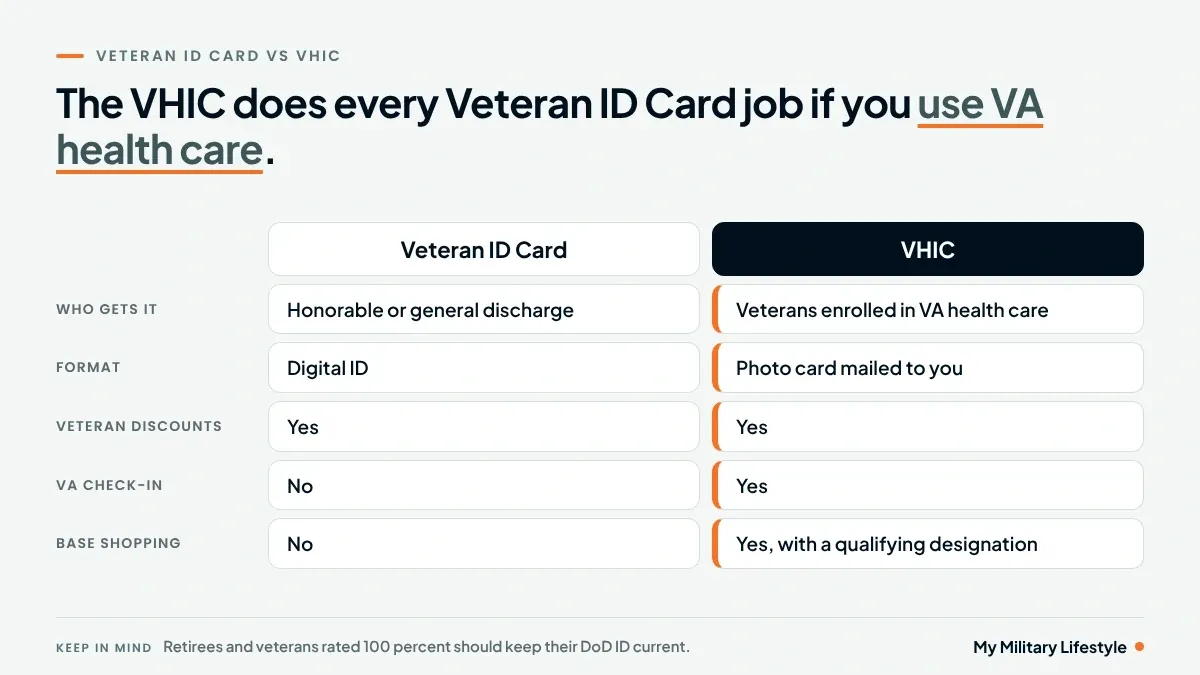
The VHIC is for veterans enrolled in VA health care.
The Veteran ID Card, often shortened to VIC, is a separate digital ID from VA, built mainly for veterans who are not enrolled in VA health care and simply want proof of service for discounts.
VA says you only need one card to prove veteran status, so if you already carry a VHIC, you do not need a VIC.
| Card | Who can get it | Main uses | What it does not do |
|---|---|---|---|
| Veteran Health Identification Card (VHIC) | Veterans enrolled in VA health care | VA check-in, veteran discounts, TSA checkpoints, base privileges with a qualifying designation | Pay for care or open base privileges without a designation |
| Veteran ID Card (VIC) | Veterans with an honorable or general (under honorable conditions) discharge | Digital proof of service for discounts | Serve as a health care or base access credential |
| DoD ID card (CAC or USID) | Retirees, active duty, Guard and Reserve members, 100 percent disabled veterans, and eligible family members | Base access and full privileges for the cardholder's status | Prove VA health care enrollment |
| State veteran designation on a driver's license | Veterans who show discharge papers, such as a DD 214, to their state motor vehicle agency | Everyday ID and proof of service for discounts | Establish federal benefits or base privileges |
Which veteran ID card should you get?
If you use VA health care, or might someday, get the VHIC, because it handles every job the VIC does and several it cannot.
If you are not enrolled and do not plan to be, the Veteran ID Card from VA is a quick online application for discount purposes.
Retirees and veterans with a 100 percent rating should keep their DoD ID current through a RAPIDS office, since that card carries the broadest privileges.
Want More Out of Every Veteran Benefit You Already Carry?
Your VHIC is one piece of a bigger set of benefits, and a free My Military Lifestyle membership helps you use them all.
- Members-only discounts: exclusive offers you claim through My Military Lifestyle, beyond the public directory
- A personal feed: topics matched to your branch and the base closest to home
- Fresh guides by email: new articles on VA health care, base access, and veteran savings as they publish
- Members-only content: in-depth guides and checklists reserved for members
How to Replace, Renew, or Update Your VHIC
A lost or expired card does not end your VA health care enrollment.
It only means you need to request a new one.
If your card is lost or stolen
There are three ways to replace it.
Over the phone, VA asks a set of identity questions before it mails a new card.
At your nearest VA medical center, show a state license, passport, or similar government photo ID, or answer those same identity questions.
Online, log in to AccessVA with Login.gov, ID.me, CLEAR, or a DoD CAC and request the replacement.
If your card is about to expire
Check the expiration date printed on the front.
VA lets you request a new card ahead of that date, inside the renewal window listed in the timeline table above, so plan the request before a trip that depends on the card.
An expired card can also cost you base access, because your installation enrollment ends with the card and you will need to reenroll with the new one.
If your designation, branch, or address is wrong
If your new service-connected rating, Purple Heart, or former POW status is missing from the card, the enrollment system probably had not caught up when VA printed it.
Contact the enrollment coordinator at your VA medical center, bring documentation if they ask for it, and request a new card only after they confirm the update.
If you moved recently, update your address with VA before you request anything, so the card does not go to your old mailbox.
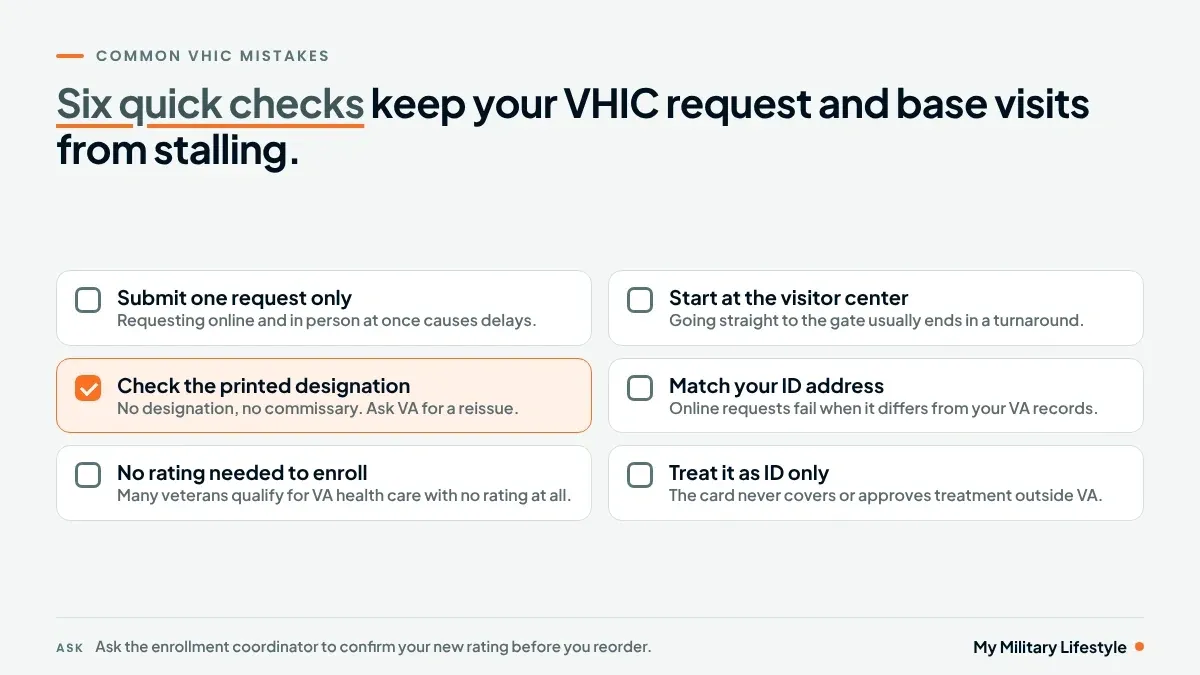
Common VHIC Mistakes That Slow Veterans Down
- Requesting twice: submitting both an online and an in-person request causes delays instead of speeding things up.
- Skipping the visitor center: driving straight to the gate on a first visit usually ends in a turnaround.
- Assuming every VHIC opens the commissary: without a qualifying designation, the card covers VA care and discounts only.
- Assuming you need a rating to enroll: many veterans qualify for VA health care with no service-connected rating at all.
- Ignoring a missing designation: a card printed before your rating posted will not get you into the commissary until it is reissued.
- Letting the address go stale: an online request fails when your ID address does not match VA records.
- Treating the card as insurance: the card never covers or approves treatment outside VA.
If a new rating is what just added SERVICE CONNECTED to your record, you may also be owed past payments, and our guide to VA disability back pay explains how VA calculates them.
How My Military Lifestyle Helps Veterans Put Their VHIC to Work
Your card proves who you are.
My Military Lifestyle helps you figure out where to use it.
- Military discount directory: a free, searchable list of brands that honor veteran status, sorted by category.
- Military base guides: free installation pages that help you find the base nearest you before your first visitor center stop.
- Military dictionary: free definitions for the acronyms on your card, your VA letters, and your base paperwork.
- Benefit guides: plain-language articles on commissary privileges, VA claims, and family benefits written for veterans and their households.
A free account ties it together with a feed built around your branch and nearest base, members-only discounts, and new guides by email.
Carry the card, and let My Military Lifestyle help you put every benefit behind it to use.
Frequently Asked Questions About the Veteran Health Identification Card
Is the VHIC free?
Yes, VA issues the VHIC free of charge to veterans enrolled in VA health care.
Can I get a VA ID card online?
Yes, once you are enrolled in VA health care, you can request the card through AccessVA with a Login.gov, ID.me, CLEAR, or DoD CAC sign-in by uploading a qualifying photo and a copy of your photo ID.
How long does it take to get a VHIC?
Delivery is usually quick for U.S. addresses and slower for overseas addresses.
See the delivery and renewal timeline table in this guide for VA's current estimates and when to follow up.
Do I need a disability rating to get a veteran health identification card?
No, enrollment in VA health care is the only requirement, and many veterans qualify for enrollment without any service-connected rating.
Is the veteran health identification card a REAL ID?
It is not a state-issued REAL ID license, but TSA accepts the VHIC as identification at airport checkpoints.
At military installations, the VHIC itself counts as an acceptable credential for enrollment, so you do not need a separate REAL ID if your card carries a qualifying designation.
Is a VA ID card considered a military ID?
No, the VHIC is issued by VA, while military IDs such as the CAC and USID are issued by the Department of Defense through DEERS, although DoD accepts a VHIC with a qualifying designation for base access and shopping privileges.
Can a VA ID card get you on base?
It can if the card shows SERVICE CONNECTED, PURPLE HEART, FORMER POW, or MEDAL OF HONOR.
You must enroll it at the installation visitor center on your first visit, where staff check your identity, background, and eligibility.
Can a spouse get a VA ID card?
No, the VHIC is issued only to the enrolled veteran, but an approved primary family caregiver can use a REAL ID-compliant license and a VA caregiver letter for commissary and exchange privileges.
Can I still get VA care if I forget my card?
Yes, you don't need the card to receive care, and staff can verify your identity another way.
What happens to my old VA ID card?
VA asks you to destroy any older veterans identification card by cutting it up or shredding it.
The current VHIC replaced those cards and protects your personal information better.
How do I get a new VA ID card if mine expired?
Request a replacement online through AccessVA, by phone with the VA health benefits line, or in person at a VA medical center.
Your health care enrollment stays active while you wait, but re-enroll the new card at any installation you use for shopping.
Which businesses accept a VHIC for veteran discounts?
Most businesses that offer veteran pricing accept a VHIC as proof of service, and you can find them by category in the free My Military Lifestyle military discount directory.
To unlock members-only discounts and get new veteran benefit guides by email, create your My Military Lifestyle account at no cost.







No comments yet. Be the first!