



For veterans enrolled in VA healthcare, the Veteran Health Identification Card (VHIC) is more than an identification card used at medical appointments. It helps verify enrollment, establish veteran status for participating civilian discounts and, for certain eligible veterans, access military shopping and recreational facilities. Understanding which benefits apply to you is the difference between merely carrying the card and putting it to practical use.
What Is a VHIC?
The VHIC is a free and official photo identification card issued to veterans enrolled in VA healthcare. It supports identification at VA medical appointments and may display qualifying designations such as SERVICE CONNECTED, PURPLE HEART or FORMER POW. The card is not health insurance, a payment method, or blanket authorization for military installation access.
Official resource: VA: Get a Veteran Health Identification Card
What Benefits Can You Use With a VHIC?
VA healthcare identification
Present the card when checking in for VA appointments to help staff verify your identity. The physical card is convenient, but eligible enrolled veterans can still receive VA healthcare without it. Coverage, referrals, and copayments are determined separately.
Discounts at participating businesses
Many retailers, restaurants, hotels, and service providers accept a VHIC as proof of veteran status for voluntary discounts. Always confirm the business’s policy before purchasing; acceptance and savings are not guaranteed.
Official resource: VA: Types of Veteran ID Cards
Commissary, Exchange, and recreation access
Certain veterans with service-connected disabilities, Purple Heart recipients, and former prisoners of war qualify for expanded military Commissary, Exchange, and designated morale, welfare, and recreation privileges. A qualifying VHIC may display SERVICE CONNECTED, PURPLE HEART, or FORMER POW. Not every VHIC holder qualifies. Installation entry may also require registration, identity verification, and security screening.
For eligible households, Commissary prices may offer grocery savings, but compare actual prices, surcharges, travel costs, and local alternatives. Recreational services and availability vary by installation; confirm eligibility and access before traveling.
Official resource: VA and DoD: Installation access updates
Who Is Eligible?
The central requirement is VA healthcare enrollment. A service-connected disability rating is not universally required: eligibility can depend on service, discharge circumstances, income, qualifying exposures, and other criteria. The VA’s eight priority groups affect some healthcare costs and copayments; the card alone does not establish the extent of covered care.
Official resource: VA: Healthcare eligibility
Official resource: VA: Apply for healthcare

How to Get Your VHIC
1. Enroll first. Apply for VA healthcare if you are not already enrolled. After enrollment and the VA welcome call, request the card.
2. Choose online or in person. Use AccessVA and an accepted sign-in method, or ask the enrollment coordinator at a VA medical center to assist.
3. Prepare your documents. Online requests require a recent qualifying color photograph and current government-issued photo ID. Follow the VA’s photo and address instructions.
4. Submit once and await delivery. VA guidance estimates roughly 7–14 days for domestic delivery. Duplicate requests may delay processing.
Official resource: AccessVA: Online VHIC request
Official resource: VA: Find a medical facility
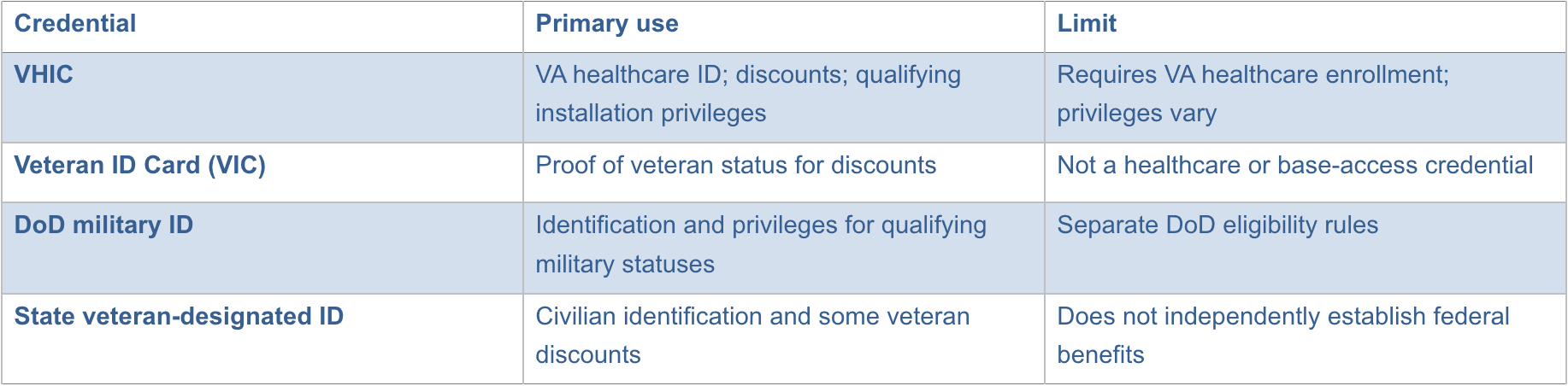
VHIC vs. Other Veteran Identification
Replacing a Lost, Damaged, or Expiring VHIC
A missing card does not automatically end healthcare enrollment. Request replacement through VA channels, including AccessVA or your VA medical center. Renewal is available within one year before the expiration date. If your name, address, or qualifying status has changed, contact your enrollment coordinator before requesting an updated card.
Official resource: VA: Replace or renew your VHIC
Common Mistakes to Avoid
- Assuming every VHIC provides Commissary access; qualifying status and installation procedures still matter.
- Assuming a disability rating is necessary for all VA healthcare enrollment.
- Submitting multiple applications or using outdated My HealtheVet application instructions.
- Failing to update your name, address, or eligibility designation.
- Treating the VHIC as insurance or authorization for non-VA medical care.
Frequently Asked Questions
Is the VHIC free? Yes. Initial and replacement cards are free.
Can I receive care without the physical card? Yes, if otherwise eligible and enrolled; staff can verify identity through other procedures.
Can I get one without a disability rating? Yes, if you qualify for and enroll in VA healthcare.
Does it guarantee base access? No. Only qualifying veterans have applicable privileges, and installation screening may be required.
Can family members use my VHIC? No. It identifies the individual veteran; family eligibility is determined separately.
Make the Most of Your VHIC
The VHIC began as a practical healthcare identification credential, but its usefulness can extend to civilian discounts and, for qualifying veterans, military shopping and recreation. Start by confirming healthcare enrollment, reviewing the designation on your card, and checking the privileges for which you personally qualify. For related guidance, explore My Military Lifestyle’s articles on VA healthcare, commissary savings, and veteran discounts.
A Note on Accuracy: We work hard to provide accurate, useful information for military members, veterans, and their families. Still, military life is nuanced, individual circumstances differ, and policies can change. If you notice an error or information that needs updating, please let us know. We appreciate your help in keeping My Military Lifestyle as useful and reliable as possible.








No comments yet. Be the first!