



Many veterans who apply for federal jobs might think the process works the same way it does for everyone else. Submit a résumé, wait, and hope for the best.
That makes sense, but it leaves out a lot.
The federal government has specific hiring paths designed to help eligible veterans compete for civilian jobs. Some give you preference over other applicants. Others allow agencies to hire you without going through the traditional competitive process.
And if you don't know these opportunities exist, you could be applying for jobs the same way as the general public when you actually qualify for a different hiring path.
Here's how five federal hiring advantages work, who qualifies, and how to use them when searching for jobs on USAJOBS.
1. Veterans' Preference: An Advantage in Federal Hiring
Veterans' Preference is one of the most widely recognized federal hiring benefits.
It gives eligible veterans priority under certain federal competitive hiring procedures. But contrary to popular belief, simply serving in the military doesn't automatically qualify everyone.
Eligibility depends on factors such as when you served, qualifying campaigns or medals, and service-connected disabilities.
How Does Veterans' Preference Work?
There are two main preference levels:
- 5-point preference (TP): Generally applies to veterans who meet qualifying active-duty service requirements involving certain periods, campaigns, or military awards.
- 10-point preference (CP, CPS, XP): Applies to certain veterans with qualifying service-connected disabilities, Purple Heart recipients, and eligible family members.
The categories have additional requirements. For example, CP generally identifies veterans with a compensable service-connected disability rated at least 10% but less than 30%, while CPS generally applies to qualifying veterans rated 30% or higher.
Under traditional numerical rating procedures, preference points may be added to a passing examination score.
However, not every federal hiring process uses numerical scores. Under category rating, eligible preference applicants receive priority within applicable qualification categories.
Important: Veterans' preference doesn't guarantee a job, and it doesn't automatically make you eligible for every veterans-only announcement. You must still meet the position's qualifications.
Check your veterans' preference eligibility through OPM.
2. Veterans Recruitment Appointment (VRA): A Noncompetitive Hiring Path
Want to avoid competing through the traditional public hiring process?
The Veterans Recruitment Appointment, or VRA, allows federal agencies to appoint eligible veterans to certain positions without using the standard competitive hiring process.
That means an agency may be able to hire you directly into a qualifying position.
Who Qualifies for VRA?
You may qualify if you meet at least one of these conditions:
- You are a disabled veteran.
- You served on active duty during a war or in a campaign or expedition for which a campaign badge was authorized.
- You received an Armed Forces Service Medal for participation in a qualifying military operation.
- You separated from active duty within the past three years under qualifying conditions.
Applicable discharge requirements also apply. For the recently separated category, qualifying active-duty service must meet the relevant statutory requirements.
VRA appointments are limited to positions at GS-11 or below, or equivalent grades.
A VRA appointment generally includes a two-year trial period. After successfully completing the required service, eligible employees are converted to the competitive service.
Important: VRA is an optional hiring authority. Agencies can use it, but they aren't required to appoint every eligible veteran through it.
3. The 30% or More Disabled Veteran Hiring Authority
If you have a qualifying service-connected disability rating of 30% or higher, you may have another valuable hiring option.
The 30% or More Disabled Veteran hiring authority allows agencies to make noncompetitive appointments without the GS-11 grade restriction that applies to VRA.
That means qualified veterans may be considered for GS-12, GS-13, and higher-level positions through this authority.
Who Qualifies?
Eligibility generally includes veterans who:
- Have a VA disability rating of 30% or more, or
- Meet the applicable qualifying military disability determination requirements.
You must also meet the position's qualifications.
Unlike a VRA appointment, this authority generally begins with a time-limited appointment of at least 60 days. The agency may then convert the veteran to a career or career-conditional appointment without further competition.
Important: This authority doesn't guarantee an appointment or eliminate the need to demonstrate that you're qualified.
If you have a qualifying disability rating, ask agency recruiters or HR contacts whether they're considering candidates under this authority.
4. Veterans Employment Opportunities Act (VEOA): Access More Federal Jobs
Here's a hiring advantage many veterans overlook.
Some federal job announcements are open under merit promotion procedures, which often involve competition among current or former federal employees and other eligible applicants.
The Veterans Employment Opportunities Act, or VEOA, allows certain eligible veterans to compete for qualifying positions advertised under those procedures.
Who Qualifies for VEOA?
Eligibility generally includes:
- Preference-eligible veterans, or
- Veterans who completed at least three years of active service under qualifying conditions.
Additional discharge and service requirements apply.
Unlike VRA or the 30% disabled veteran authority, VEOA is not a noncompetitive hiring authority.
You still compete for the position and must meet its qualifications.
The advantage is access to certain announcements you might otherwise assume are unavailable to you.
For veterans seeking federal employment, especially those transitioning into higher-level positions, this can substantially expand the jobs worth reviewing.
5. Schedule A: Another Option for Veterans With Disabilities
Schedule A is a separate noncompetitive hiring authority for qualified individuals with disabilities.
It isn't exclusively for veterans, but some veterans with service-connected disabilities may qualify.
How Does Schedule A Work?
Federal agencies may use Schedule A to hire eligible applicants with qualifying disabilities outside the traditional competitive process.
However, having a VA disability rating doesn't automatically establish Schedule A eligibility.
Applicants generally need appropriate disability documentation from an authorized medical professional, licensed rehabilitation professional, or qualifying government agency.
They must also meet the job's qualification requirements.
If you have a service-connected disability, it may be worth exploring Schedule A alongside other veteran hiring authorities.
Learn about disability hiring paths on USAJOBS.
Which Federal Hiring Path Should You Use?
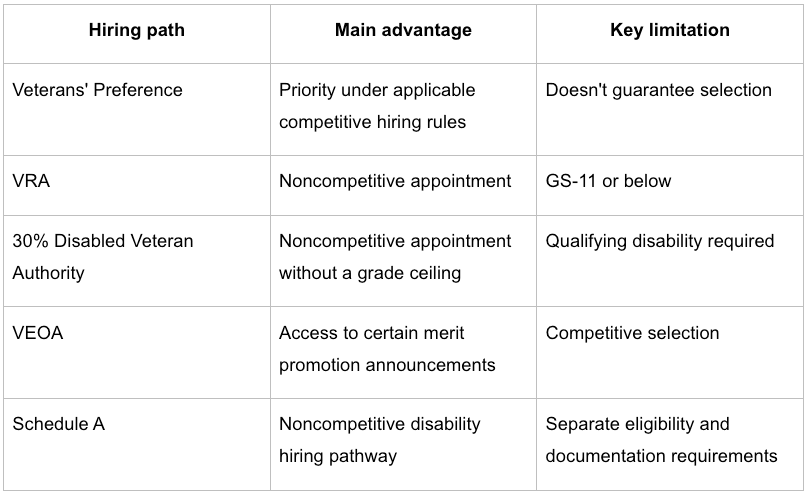
You may qualify for more than one pathway.
Don't limit yourself to just one.
How to Find Federal Jobs for Veterans on USAJOBS
USAJOBS.gov is the federal government's primary employment website.
When searching for positions:
- Visit USAJOBS.gov.
- Enter your desired job title, location, or federal agency.
- Use the Hiring Path filters to identify positions open to veterans or other categories for which you qualify.
- Read the announcement's This job is open to and Required Documents sections.
- Confirm your eligibility and submit all required documentation before the deadline.
Not every federal hiring opportunity is publicly advertised through USAJOBS.
If you're eligible for a noncompetitive appointment, consider contacting agency veterans employment program managers, recruiters, or appropriate HR representatives directly.
What Documents Do You Need?
Before applying, have these documents ready:
- DD-214: Proof of military service, with discharge information when required.
- VA disability documentation: If claiming disability-related preference or hiring eligibility.
- SF-15: Application for 10-Point Veteran Preference, when required.
- Federal résumé: Tailored to the qualifications and current résumé requirements in the announcement.
- Additional supporting documents: Any forms or certifications specifically requested by the agency.
A DD-214 Member 4 copy is commonly accepted, but other copies containing the necessary service and discharge information may also be acceptable.
Always follow the announcement's documentation instructions.
If you've lost your DD-214, you can request military service records through the National Archives.
The Bottom Line
Federal hiring isn't always as straightforward as submitting a résumé and waiting.
If you're a veteran, you may qualify for hiring advantages that give you priority in competition, access to additional job announcements, or eligibility for a noncompetitive appointment.
The key is knowing which pathways apply to you.
Before submitting your next federal application, check your veterans' preference eligibility, review the hiring authorities you qualify for, and make sure your supporting documents are ready.
Start at USAJOBS.gov, use the Veterans hiring path filter, and look beyond the standard public application process when you're eligible for additional opportunities.
Eligibility Disclaimer: Federal hiring authorities have specific statutory and regulatory requirements. Eligibility and appointment procedures depend on your military service, discharge status, disability documentation, and the position involved. Verify requirements with the Office of Personnel Management, USAJOBS, or the hiring agency before applying.










No comments yet. Be the first!